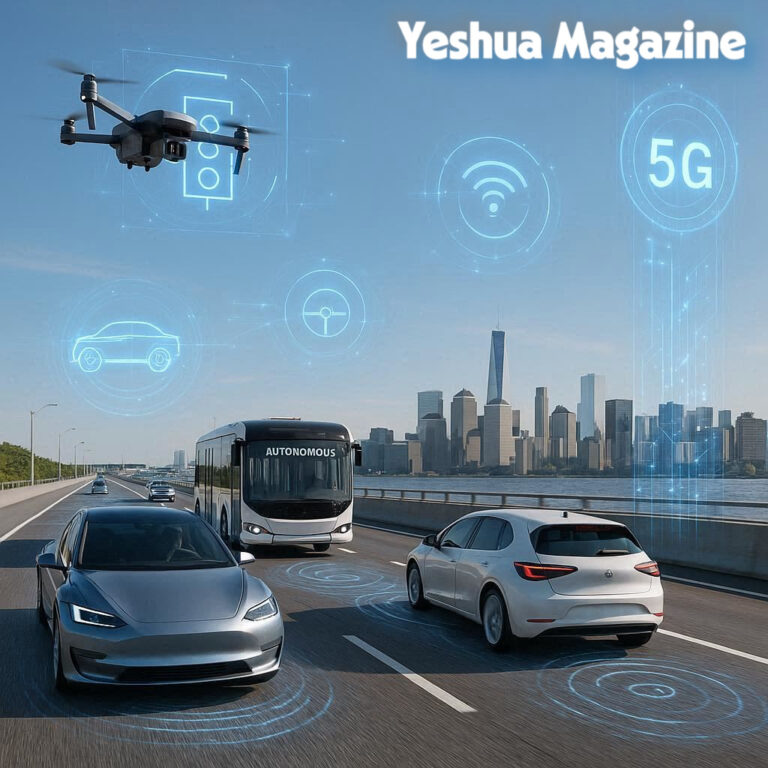
5G Technology in Connected Vehicles: Revolutionizing the Future of Mobility
Introduction: The Dawn of Hyperconnected Vehicles
The automotive industry is experiencing a digital revolution, and 5G technology stands at its core. As vehicles evolve from mechanical machines into sophisticated computers on wheels, connectivity becomes as crucial as horsepower once was. Fifth-generation wireless technology promises to transform how vehicles communicate with each other, infrastructure, and the digital world around them.
Connected vehicles equipped with 5G capabilities can exchange vast amounts of data in milliseconds, enabling features previously confined to science fiction. From real-time traffic optimization to collaborative autonomous driving, 5G connectivity unlocks possibilities that fundamentally change our relationship with transportation.
This comprehensive guide explores how 5G technology integrates with modern vehicles, the transformative applications it enables, challenges facing implementation, and what the future holds for hyperconnected mobility.
Understanding 5G Technology Fundamentals
Fifth-generation wireless technology represents a quantum leap beyond previous cellular generations. While 4G LTE improved mobile internet speeds, 5G fundamentally reimagines wireless communication with three key characteristics that make it revolutionary for automotive applications.
Ultra-High Speed Data Transfer
5G networks deliver theoretical peak speeds exceeding ten gigabits per second, roughly one hundred times faster than 4G LTE. Real-world speeds typically range from one to three gigabits per second, still dramatically faster than previous generations. This bandwidth enables vehicles to transmit and receive massive data volumes instantaneously.
High-definition sensor data from cameras, radar, and lidar systems can stream to cloud processing centers for analysis. Map updates, entertainment content, and software patches download in seconds rather than minutes or hours. This speed transforms vehicles from isolated systems into nodes in vast information networks.
Ultra-Low Latency Communication
Perhaps more critical than raw speed is 5G’s remarkably low latency—the delay between sending and receiving data. While 4G networks typically exhibit latency around fifty milliseconds, 5G reduces this to one millisecond or less in optimal conditions.
For connected vehicles, especially autonomous ones, this near-instantaneous communication proves essential. A vehicle traveling at highway speeds covers significant distance in fifty milliseconds. Reducing latency to single-digit milliseconds enables real-time responses to changing conditions, making safety-critical applications viable.
Massive Device Connectivity
5G networks support up to one million connected devices per square kilometer, compared to roughly one hundred thousand for 4G. This massive connectivity capacity becomes crucial as vehicles, infrastructure, pedestrian devices, and urban sensors all require simultaneous connections.
In dense urban environments where thousands of vehicles, traffic signals, and smart city systems operate within small areas, 5G’s capacity ensures reliable connectivity without network congestion degrading performance.
Vehicle-to-Everything (V2X) Communication
The most transformative application of 5G in automotive contexts is Vehicle-to-Everything communication, commonly abbreviated as V2X. This umbrella term encompasses several communication pathways that together create a comprehensive connected transportation ecosystem.
Vehicle-to-Vehicle (V2V) Communication
V2V enables direct communication between vehicles, allowing them to share position, speed, direction, acceleration, and intention data. When equipped with 5G V2V, vehicles become aware of surrounding traffic beyond what sensors can detect directly.
A vehicle several cars ahead suddenly braking can instantly alert vehicles behind it, enabling proactive responses before human drivers even perceive the situation. Vehicles negotiating intersections can coordinate right-of-way, eliminating uncertainty and reducing accidents. Cooperative adaptive cruise control allows vehicle platoons to travel in tight formations, improving traffic flow and fuel efficiency.
The low latency of 5G makes V2V communication practical for safety applications where milliseconds matter. Unlike previous communication standards with higher latency, 5G enables real-time coordination that prevents accidents rather than merely reacting to them.
Vehicle-to-Infrastructure (V2I) Communication
V2I connects vehicles with road infrastructure including traffic signals, road sensors, toll systems, parking facilities, and charging stations. This bidirectional communication creates intelligent transportation systems that optimize traffic flow and enhance safety.
Traffic signals can adjust timing based on actual traffic conditions, prioritizing directions with heavier flow or granting priority to emergency vehicles. Smart highways can warn drivers of hazards ahead, suggest optimal speeds to catch green lights, or dynamically adjust speed limits based on weather and congestion.
Vehicles approaching parking facilities can receive real-time availability information and reserve spots before arrival. Electric vehicles can identify available charging stations, check pricing, and even pre-authenticate for seamless charging experiences.
Vehicle-to-Pedestrian (V2P) Communication
V2P extends connectivity to smartphones and wearable devices carried by pedestrians and cyclists. This capability addresses vulnerable road users who lack the protection of vehicle structures.
A pedestrian stepping into the street while looking at their phone can trigger warnings to approaching vehicles, which can automatically brake if the driver doesn’t respond. Cyclists in blind spots can broadcast their presence to vehicles preparing to turn. Visually impaired pedestrians using specialized devices can receive assistance crossing intersections safely.
Vehicle-to-Network (V2N) Communication
V2N provides vehicles with connections to cloud services, enabling access to vast computing resources and data repositories beyond onboard systems. This connectivity supports advanced navigation, real-time traffic information, weather updates, and cloud-based artificial intelligence processing.
Over-the-air software updates keep vehicles current with the latest features and security patches without dealership visits. Predictive maintenance systems analyze vehicle telemetry in cloud platforms, identifying potential failures before they occur. Entertainment systems access streaming services with quality rivaling home experiences.
Enabling Autonomous Driving with 5G
While autonomous vehicles rely primarily on onboard sensors and computing for immediate driving decisions, 5G connectivity significantly enhances their capabilities and safety margins.
Collective Perception and Shared Intelligence
Individual autonomous vehicles have limited sensor range and can be fooled by adverse weather or unusual situations. 5G enables collective perception where multiple vehicles and infrastructure sensors share their observations, creating comprehensive environmental awareness far exceeding individual capability.
An autonomous vehicle approaching a blind intersection can receive shared sensor data from vehicles already at the intersection or infrastructure cameras providing overhead views. This collective intelligence eliminates blind spots and enables confident navigation of complex scenarios.
High-Definition Mapping and Localization
Autonomous vehicles require extremely precise location data and detailed maps showing lane positions, traffic signs, and road features down to centimeter-level accuracy. These high-definition maps consume enormous data volumes and require frequent updates as road conditions change.
5G connectivity enables continuous map updates and cloud-based localization services that enhance GPS accuracy. Vehicles can upload mapping data captured during normal driving, creating crowdsourced maps that stay current with construction, new signage, and changing road conditions.
Remote Assistance and Teleoperation
Even advanced autonomous systems occasionally encounter situations beyond their capabilities. 5G’s low latency enables remote human operators to assist or temporarily control vehicles when needed.
An autonomous vehicle uncertain how to proceed at an unmarked construction zone can connect with a remote operator who views real-time video feeds and either guides the vehicle or briefly takes direct control. This remote assistance safety net increases confidence in autonomous deployment while systems continue learning and improving.
Fleet Coordination and Optimization
Commercial autonomous vehicle fleets benefit enormously from 5G connectivity enabling central coordination. Ride-sharing services can optimize vehicle positioning based on predicted demand, minimizing empty miles and customer wait times. Delivery fleets can dynamically reroute based on real-time traffic conditions and new order priorities.
Vehicles can share learning experiences, so improvements discovered by one vehicle immediately benefit the entire fleet. This collective learning accelerates autonomous technology advancement while ensuring consistent behavior across all vehicles.
Enhancing Driver Experience and Safety
Even in conventional human-driven vehicles, 5G connectivity delivers substantial benefits that improve safety, convenience, and entertainment.
Real-Time Hazard Warnings
5G-connected vehicles can receive instant warnings about hazards ahead including accidents, debris, ice, fog, or stopped vehicles. Unlike radio traffic reports that provide general area information with significant delays, V2X warnings specify exact locations and nature of hazards.
Electronic brake light warnings alert drivers when vehicles ahead brake suddenly, even if those vehicles aren’t directly visible. Wrong-way driver alerts can warn both the errant driver and approaching traffic, potentially preventing catastrophic collisions.
Cooperative Adaptive Cruise Control
Traditional adaptive cruise control maintains safe following distances using onboard radar. Cooperative systems using 5G V2V communication achieve superior performance by receiving direct information about lead vehicle acceleration and braking intentions.
This enables smoother traffic flow, tighter following distances without compromising safety, and better fuel efficiency through optimized acceleration and deceleration. Entire platoons of vehicles can coordinate movements, eliminating the accordion effect where small speed variations amplify through traffic.
Enhanced Navigation and Route Planning
5G-connected navigation systems access real-time traffic data with unprecedented detail and accuracy. Rather than relying on general congestion reports, these systems know specific lane closures, accident locations, and even individual traffic signal timing.
Predictive routing anticipates traffic conditions throughout your journey, suggesting departure times that minimize travel time. Integration with parking and charging infrastructure helps electric vehicle drivers plan routes ensuring adequate charging opportunities and available parking at destinations.
Immersive Entertainment and Productivity
High-speed 5G connectivity transforms vehicle interiors into mobile entertainment and productivity centers. Passengers can stream high-definition video, participate in video conferences, or access cloud-based applications without quality degradation.
As autonomous driving capabilities increase, 5G connectivity becomes essential for making commute time productive or entertaining rather than merely tolerable. The vehicle cabin evolves into an extension of home and office rather than dead time between locations.
Infrastructure and Implementation Challenges
Despite compelling benefits, widespread 5G implementation in connected vehicles faces significant obstacles requiring time and investment to overcome.
Network Coverage and Reliability
5G networks currently cover primarily urban areas with significant coverage gaps in rural regions and along highways. For connected vehicle features to work reliably, consistent coverage across entire transportation networks is essential.
The higher frequencies used by 5G for maximum speed have shorter range and poorer building penetration than 4G, requiring denser infrastructure deployment. Achieving comprehensive coverage requires enormous investment in cell towers and small cell installations.
Standardization and Interoperability
Multiple competing standards for cellular V2X communication create fragmentation concerns. Ensuring vehicles from different manufacturers using different network equipment can communicate reliably requires industry-wide standardization efforts still in progress.
International differences in spectrum allocation and regulatory approaches complicate global vehicle deployment. Manufacturers must navigate varying requirements across markets, potentially limiting feature availability or requiring different hardware for different regions.
Cybersecurity and Privacy Concerns
Connected vehicles constantly transmitting location and operational data create significant privacy concerns. Ensuring this data remains secure while enabling beneficial applications requires sophisticated encryption and access controls.
The increased connectivity also expands potential attack surfaces for malicious actors. Protecting vehicle systems from hacking attempts that could compromise safety demands robust security architectures and constant vigilance against emerging threats.
Cost and Business Models
Integrating 5G capability into vehicles increases manufacturing costs through required modems, antennas, and associated electronics. Ongoing connectivity services require subscription fees, raising questions about who pays—manufacturers, vehicle owners, or some shared model.
Developing sustainable business models that justify infrastructure investment while remaining affordable for consumers challenges the entire ecosystem. Some connectivity features may require subscriptions, potentially creating equity concerns where safety benefits become available only to those who can afford them.
Legacy Vehicle Integration
The vehicle fleet turns over slowly, with cars remaining in service for ten to fifteen years on average. Even if all new vehicles ship with 5G connectivity today, full fleet penetration requires over a decade. Maximizing V2X benefits requires high penetration rates, creating a chicken-and-egg problem where limited deployment reduces incentives for participation.
Retrofitting older vehicles with 5G connectivity presents technical and economic challenges. Without comprehensive fleet connectivity, infrastructure investments may seem premature, while lack of infrastructure reduces incentives for vehicle connectivity.
The Future of 5G-Connected Vehicles
Looking forward, 5G technology will become increasingly integral to automotive ecosystems as networks mature and adoption accelerates.
Evolution Toward 6G and Beyond
Even as 5G deployment continues, research into sixth-generation wireless technology has begun. 6G promises even faster speeds, lower latency, and new capabilities like integrated sensing and communications that could further enhance connected vehicle applications.
Future wireless technologies may eliminate distinctions between communication and sensing, where the same systems transmit data and map environments. This convergence could revolutionize how vehicles perceive and interact with their surroundings.
Smart City Integration
Connected vehicles represent one component of comprehensive smart city ecosystems. 5G enables integration between transportation, energy, emergency services, and urban planning systems that optimize city operations holistically.
Traffic management systems could coordinate with public transit, parking, and delivery systems to minimize congestion and emissions. Emergency vehicles could receive priority throughout their routes while traffic dynamically reroutes to accommodate them. These integrated systems maximize efficiency and sustainability beyond what isolated optimization achieves.
Mobility as a Service
5G connectivity enables seamless integration of various transportation modes into unified mobility services. Users could plan and pay for multimodal journeys combining personal vehicles, ride-sharing, public transit, bike-sharing, and micro-mobility options through single applications.
Connected vehicles become nodes in transportation networks rather than isolated assets, optimizing resource utilization and reducing the total number of vehicles needed to serve transportation demand. This shift from vehicle ownership to mobility services could fundamentally reshape urban transportation and automotive business models.
Environmental Benefits
Optimized traffic flow enabled by connected vehicles reduces fuel consumption and emissions through smoother acceleration, less idling, and shorter travel times. Better route planning avoids congestion that wastes fuel and time.
Electric vehicles benefit particularly from connectivity that optimizes charging schedules based on grid conditions and renewable energy availability. Vehicle-to-grid capabilities allow EVs to support grid stability while maximizing charging cost savings, accelerating electric vehicle adoption.
Conclusion: Connecting the Road Ahead
5G technology represents a foundational enabler for the connected, autonomous, shared, and electric vehicle future taking shape. While challenges remain in deployment, standardization, and business model development, the trajectory toward hyperconnected mobility appears inevitable.
The benefits spanning safety, efficiency, convenience, and environmental sustainability provide compelling justification for the substantial investments required. As 5G networks mature and vehicle integration deepens, we will experience transportation transformation as profound as the original introduction of automobiles themselves.
The road ahead connects us not just to destinations but to each other and the intelligent infrastructure supporting our journeys. 5G technology provides the invisible foundation making this connected future possible, transforming vehicles from isolated machines into collaborative participants in comprehensive mobility ecosystems.
Frequently Asked Questions (FAQ)
What is 5G technology in vehicles?
5G technology in vehicles refers to fifth-generation wireless connectivity integrated into automobiles, enabling ultra-fast data transmission, low-latency communication, and vehicle-to-everything (V2X) connectivity. This technology allows vehicles to communicate with other vehicles, infrastructure, pedestrians, and cloud services in real-time, supporting advanced safety features, autonomous driving, and enhanced user experiences.
How is 5G different from 4G in connected cars?
5G offers speeds up to one hundred times faster than 4G, with latency reduced from around fifty milliseconds to one millisecond or less. This dramatic improvement enables real-time safety applications, high-definition sensor data streaming, and immediate responses to changing conditions. 5G also supports one million devices per square kilometer compared to 4G’s one hundred thousand, crucial for dense urban environments with many connected vehicles and infrastructure.
Do I need 5G in my car right now?
Current vehicles function perfectly without 5G, though many newer models include 5G capability for future-proofing. As 5G networks expand and V2X infrastructure deploys, connected features will become increasingly valuable. If purchasing a new vehicle you plan to keep for several years, 5G connectivity ensures access to emerging features as they become available. However, essential vehicle functions don’t currently depend on 5G.
Will 5G make autonomous vehicles safer?
Yes, significantly. 5G enables collective perception where vehicles share sensor data, eliminating blind spots and extending awareness beyond individual sensor ranges. Low latency allows real-time coordination between vehicles and infrastructure, preventing accidents through proactive communication. Remote assistance capabilities provide safety nets when autonomous systems encounter unfamiliar situations. However, autonomous vehicles still rely primarily on onboard sensors for immediate decisions.
How much does 5G connectivity cost in vehicles?
Costs vary by manufacturer and service level. Vehicle purchase prices may include modest premiums for 5G hardware, typically a few hundred dollars. Ongoing connectivity often requires subscriptions ranging from ten to thirty dollars monthly, though some manufacturers include complimentary periods. Premium services with enhanced features may cost more. Some basic safety features might be free while entertainment and convenience features require subscriptions.
What is V2X communication?
V2X (Vehicle-to-Everything) encompasses all communication between vehicles and other entities. This includes V2V (vehicle-to-vehicle), V2I (vehicle-to-infrastructure), V2P (vehicle-to-pedestrian), and V2N (vehicle-to-network) communication. V2X enables vehicles to exchange information about position, speed, road conditions, and intentions, creating cooperative awareness that enhances safety and efficiency beyond what individual vehicles achieve alone.
Is 5G available everywhere for connected cars?
No, 5G coverage remains primarily urban with significant gaps in rural areas and along many highways. Coverage continues expanding rapidly, but comprehensive nationwide coverage will take several years. Connected vehicle features requiring 5G may work inconsistently or fall back to 4G where 5G is unavailable. This coverage limitation currently restricts the full potential of 5G-enabled vehicle features.
Can 5G in cars be hacked?
Like any connected technology, 5G vehicle systems have potential cybersecurity vulnerabilities. However, automotive manufacturers implement multiple security layers including encryption, authentication, isolated systems, and intrusion detection. The industry treats cybersecurity extremely seriously given safety implications. While no system is perfectly invulnerable, properly designed 5G vehicle systems maintain strong security against realistic threats. Regular over-the-air security updates help protect against emerging risks.
How does 5G improve traffic and reduce congestion?
5G enables real-time traffic management where vehicles and infrastructure share information continuously. Traffic signals can adjust timing based on actual conditions rather than fixed schedules. Vehicles receive optimal routing that avoids congestion while traffic management systems can dynamically adjust speed limits and lane usage. Cooperative vehicle behavior reduces the accordion effect where small speed variations amplify through traffic, maintaining smoother flow that increases road capacity.
What role does 5G play in electric vehicles?
5G enhances electric vehicles through several pathways. Real-time charging station information helps drivers find available chargers and plan routes confidently. Smart charging optimization schedules vehicle charging when electricity is cheapest or most sustainable. Vehicle-to-grid capabilities allow EVs to support electrical grid stability. Over-the-air updates keep battery management and charging systems optimized. High-speed connectivity enables cloud-based battery health monitoring and predictive maintenance that extends battery life.