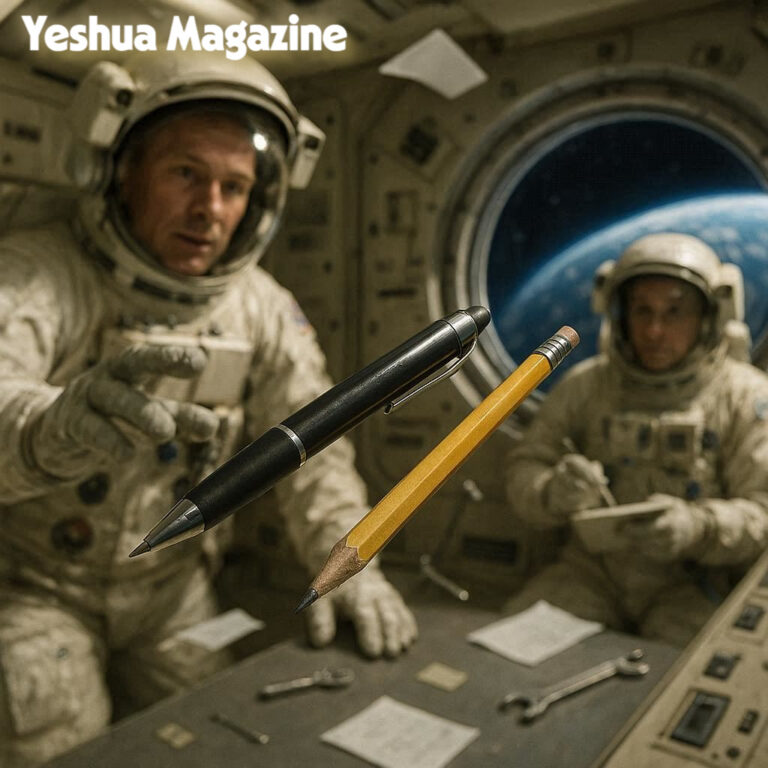
Have you ever wondered about writing in zero gravity? More importantly, can a pen or pencil actually work in space? The answer is not simple at all. In fact, it involves science, safety, and smart engineering. Moreover, there is even a famous Cold War myth involved. Therefore, this guide will explain everything clearly and in detail.
Understanding the Space Environment
First of all, space is nothing like Earth. In fact, the conditions are extreme and very different. As a result, writing tools that work on Earth may completely fail in space. Therefore, there are three main challenges for any writing instrument in space.
What Is Microgravity?
First, the biggest challenge is microgravity. In other words, there is almost no gravitational pull in space. As we know, gravity is what moves ink toward the tip of a pen. Therefore, without it, ink simply does not flow normally.
What Is Vacuum in Space?
In addition to microgravity, the second challenge is vacuum. Specifically, space has almost no air pressure. As a result, this affects how liquids behave inside a pen. Consequently, ink can evaporate or refuse to flow properly.
How Extreme Are Space Temperatures?
Furthermore, the third challenge is temperature. In particular, temperatures in space are extremely extreme. For example, in the shade, it can drop to -270°C. On the other hand, in direct sunlight, it can rise to +120°C. Therefore, most writing tools simply cannot handle such dramatic changes.
Can a Regular Pencil Work in Space?
Initially, many people think pencils are perfect for space. After all, they do not use ink. Instead, they simply rub graphite onto paper. So, surely they must work in zero gravity, right?
Technically, yes. A pencil can indeed make marks in microgravity. However, it comes with serious dangers. As a result, these dangers make pencils a very poor choice for spacecraft.
The Problem with Graphite
First of all, when you write with a pencil, tiny particles break off. On Earth, they simply fall to the ground. In space, however, they float freely in the air. Therefore, these floating particles become very dangerous.
Moreover, graphite is electrically conductive. As a result, floating graphite can easily reach electronic panels. Consequently, it can cause short circuits. In the worst case, this can damage or destroy critical spacecraft systems.
In addition to that, graphite particles can also enter an astronaut’s eyes. As a result, this can cause serious injury. Furthermore, even breathing in graphite dust is harmful over time.
The Problem with Wood
Besides graphite, standard pencils also have wooden barrels. Of course, wood is highly flammable. Furthermore, spacecraft maintain an oxygen-rich atmosphere. Therefore, fire is one of the greatest dangers in space.
In fact, NASA learned this the hard way. Specifically, the Apollo 1 disaster happened in 1967. As a tragic result, three astronauts died in a cabin fire during a ground test. After that terrible event, NASA took fire risks extremely seriously.
Consequently, using wooden pencils was completely out of the question. As an alternative, NASA also tried mechanical pencils. These have thin graphite leads instead of wood. However, the leads could still snap off. As a result, they still floated freely. Therefore, the electrical hazard remained. In conclusion, pencils were simply not safe enough.
Can a Regular Ballpoint Pen Work in Space?
Now, what about a normal ballpoint pen? On Earth, ballpoint pens work very well. Specifically, gravity pulls the ink down toward the tip. Then, the rotating ball spreads ink onto the paper. Overall, it is simple and very reliable.
Why Ballpoint Pens Fail in Zero Gravity
In space, however, this entire process breaks down. The reason is that gravity is not there to pull the ink. As a result, the ink stays wherever it is inside the cartridge. Therefore, it does not move toward the tip on its own.
The result? Consequently, the pen simply does not write. Or alternatively, it writes very poorly. For instance, ink may blob or smear unpredictably. Therefore, you simply cannot rely on it at all.
How Temperature Affects Ballpoint Pens
In addition to gravity problems, temperature is another serious issue. For example, in cold conditions, ink becomes very thick. As a result, it gets too thick to flow at all. On the other hand, in hot conditions, ink becomes too thin. Consequently, it may even turn to vapor.
Furthermore, vacuum conditions make things even worse. Specifically, ink contains liquid components. Therefore, in a vacuum, those liquids can evaporate quickly. As a result, the pen dries out very fast. In conclusion, regular ballpoint pens are simply not built for space at all.
The Famous Fisher Space Pen
Fortunately, a private American company eventually solved this problem. Specifically, it was called the Fisher Pen Company. As a result, Paul Fisher led the project in the 1960s. Moreover, he invested about one million dollars of his own money. This is an especially important point. Unlike what many people believe, NASA did not pay for the development. Instead, Fisher funded it entirely himself.
As a result of his hard work, the Fisher Space Pen was born. Its official name was the AG7. Without a doubt, it was a true engineering breakthrough.
How Does the Fisher Space Pen Work?
Essentially, the secret is a pressurized cartridge. Specifically, the cartridge is filled with nitrogen gas. As a result, the gas creates pressure of about 35 psi inside the pen. Therefore, this pressure pushes the ink toward the tip automatically. Importantly, it does not need gravity to work at all. Consequently, the pen writes in any direction. For example, upward, downward, sideways — it simply does not matter.
What Makes the Ink So Special?
In addition to the pressurized cartridge, the ink is also specially made. Specifically, it is called thixotropic ink. In other words, this ink behaves like a gel when still. However, when the ball tip rolls, it immediately becomes liquid. As a result, the ink never leaks. Furthermore, it never dries out. Most importantly, it never evaporates in a vacuum.
How Well Does It Handle Extreme Temperatures?
Moreover, the pen also works in extreme temperatures. Specifically, it operates from -45°F to +200°F. Therefore, that covers the full range of space conditions perfectly. Additionally, it even writes underwater and on wet surfaces.
As a result of all these features, NASA tested it thoroughly. Subsequently, they approved it for the Apollo missions. Since then, it has become one of the most trusted tools in all of space history.
The NASA vs Soviet Pencil Myth Debunked
Interestingly, there is a very famous story about the Space Pen. According to this story, NASA wasted millions developing it. Furthermore, people say the Soviets just used a pencil instead. Indeed, this story is repeated everywhere. However, it is simply not true.
The Real Facts Behind the Myth
In reality, here are the actual facts. First of all, Fisher paid for the pen himself. Therefore, NASA did not fund the research at all. Instead, NASA simply bought the finished pens. Moreover, they paid a fair commercial price. As a result, no taxpayer money was wasted at all.
What Did the Soviets Actually Use?
Similarly, what about the Soviets? Contrary to popular belief, they did not just use pencils. In fact, they also knew pencils were dangerous. Therefore, Soviet cosmonauts first used grease pencils. In other words, these are wax-based markers. Later on, they also switched to the Fisher Space Pen. As a result, both space programs reached the same conclusion. Ultimately, pencils were simply not safe for use in spacecraft.
What Do Astronauts Use for Writing Today?
Fortunately, the Fisher Space Pen is still used today. In fact, astronauts on the ISS use it regularly. As a result, it remains reliable and very easy to use. Additionally, it is also sold to the general public. Consequently, many people now carry it as an everyday pen.
Digital Tools on the ISS
However, astronauts now also have many more options. For instance, digital tools are very common on the ISS today. Specifically, astronauts use laptops and tablets every day. As a result, they write reports and send emails digitally. Furthermore, touchscreen styluses also work well in microgravity. Unlike ink pens, they do not use ink at all.
Voice Recorders and Dictation Software
In addition to digital tools, voice recorders are also very popular. As a result, astronauts can dictate notes very quickly. Therefore, no physical writing is needed at all. Moreover, dictation software automatically converts speech to text.
Felt-tip Markers in Space
Furthermore, felt-tip markers are yet another option. For example, Sharpie-style markers work well in microgravity. The reason is that they use capillary action to deliver ink. Therefore, gravity is simply not needed. As a result, NASA has approved some felt-tip markers for use on the ISS. Consequently, astronauts use them regularly for labeling and quick notes.
Why Gravity Matters More Than You Think
Surprisingly, we never think about gravity when we write. However, it actually plays a huge role. For example, pick up a pen on Earth. Then hold it at a downward angle. Immediately, gravity pulls the ink toward the tip. As a result, this keeps the flow steady and smooth.
What Happens When You Remove Gravity?
Now, imagine removing gravity completely. Suddenly, the ink has no direction. As a result, it does not know which way to go. Consequently, the flow becomes completely unreliable. Therefore, the pen stops working properly.
This is exactly what happens in space. In fact, every writing tool designed for Earth relies on gravity. Even just a little bit. Therefore, removing it changes everything completely. That is precisely why the Fisher Space Pen was such a big deal. Simply put, it replaced gravity with gas pressure. In conclusion, it was simple but absolutely brilliant.
The Future of Writing in Space
Looking ahead, space missions are getting longer and longer. For instance, a trip to Mars could take two to three years. Therefore, astronauts will need very reliable writing tools. Specifically, scientific logs must be kept accurately. Similarly, personal journals must be maintained. Additionally, operational records are absolutely essential.
Will Digital Tools Replace Pens in Space?
In the future, digital tools will keep improving rapidly. For example, AI voice transcription is getting very accurate. Moreover, cloud-connected tablets will become standard equipment. As a result, these will likely be the main tools for future astronauts.
However, analog tools will still matter greatly. For instance, electronics can fail unexpectedly. Similarly, batteries can die at any time. Therefore, in those critical moments, a simple pen becomes absolutely essential. Consequently, the Fisher Space Pen will likely remain part of every mission kit for years to come.
Writing on Mars: New Challenges Ahead
Furthermore, Mars presents entirely new challenges. Specifically, gravity on Mars is only 38% of Earth’s. In addition, atmospheric pressure is less than 1% of Earth’s. Therefore, writing tools must be completely redesigned for those conditions. As a result, new ink formulas and pen designs will definitely be needed. Fortunately, space engineers are already thinking seriously about this.
Key Takeaways: Pen vs Pencil in Space
Regular Pencil — Although it can write in microgravity, graphite is dangerous, wood is flammable, and floating particles risk short circuits.
Regular Ballpoint Pen — Unfortunately, it does not work in space because ink will not flow without gravity, and it fails in extreme temperatures.
Fisher Space Pen — In contrast, it works perfectly because pressurized nitrogen gas pushes ink in any direction, and special ink handles all space conditions.
Felt-tip Markers — Similarly, they work via capillary action, are NASA approved for the ISS, and are used for labeling and quick notes.
Digital Stylus and Tablet — Finally, these are the main writing tools for modern astronauts, used for all reports and data recording.
Conclusion
So, can a pen or pencil work in space? Ultimately, the answer depends on the type. On one hand, a regular pencil can make marks. However, it is far too dangerous to use safely. On the other hand, a standard ballpoint pen simply does not work at all. The reason is that gravity is missing and ink will not flow.
Fortunately, the Fisher Space Pen changed everything. Instead of gravity, it used gas pressure. Moreover, it used special ink that worked in any condition. As a result, NASA approved it and astronauts trusted it completely. Consequently, it became a true legend in space history.
Today, astronauts successfully use Space Pens, felt-tip markers, and digital tools together. Each one has its own important role. As missions get longer and go further into space, even better tools will surely follow. However, the humble Space Pen will always have its special place among the stars.
Found this helpful? Therefore, drop a comment below and let us know what you think!