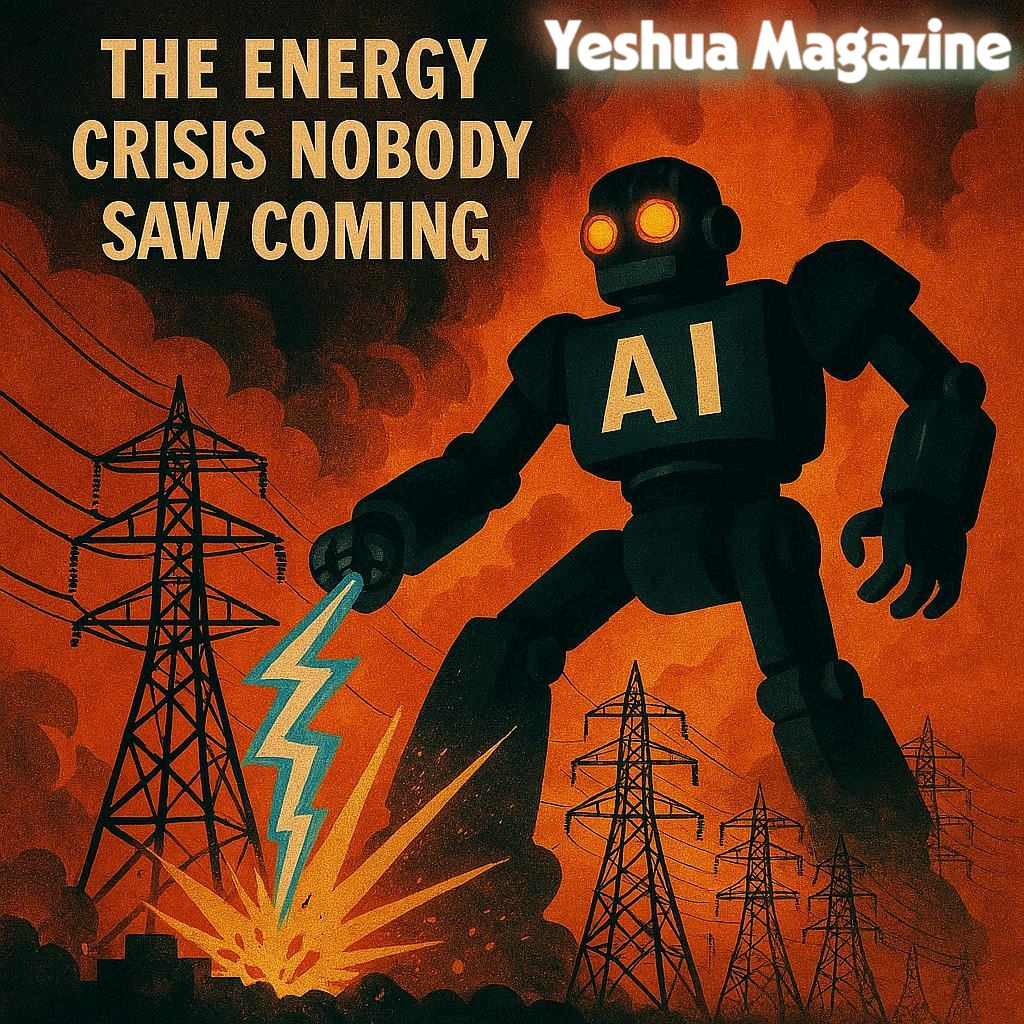


Artificial intelligence is consuming electricity at an unprecedented rate, pushing global power grids to the brink. Explore the challenges, solutions, and what this means for the future of energy and technology.
🌍 Introduction: The Hidden Battle Powering the AI Revolution
When we think about artificial intelligence, we naturally imagine chatbots, autonomous vehicles, and revolutionary breakthroughs in medicine. However, we rarely think about electricity. Yet, right now, beneath the surface of every AI query and model training run, a silent crisis is quietly unfolding. In fact, this oversight is becoming one of the most urgent challenges of our time.
As Microsoft CEO Satya Nadella recently warned, the real limit on AI isn’t chips—it’s electricity. Consequently, this realization has sent shockwaves through the tech industry, forcing giants like Google, Microsoft, and Amazon to rethink their entire infrastructure strategy.
Ultimately, power has become AI’s central bottleneck. Therefore, the countries and companies that solve this puzzle will dominate the next decade of technological innovation. Conversely, those that don’t will be left behind, watching from the sidelines as the AI revolution passes them by.
This article explores the collision between exponential AI growth and finite energy resources—and what it means for our future.
⚡ The Scale of the Problem: AI’s Insatiable Hunger for Power
📊 By the Numbers
To begin with, the statistics are staggering. According to recent data, global data center electricity consumption reached approximately 415 terawatt-hours (TWh) in 2024—about 1.5% of worldwide electricity use. By 2030, that figure is projected to exceed 900 TWh, which means nearly doubling in just six years.
In the United States alone, data centers already consume 3-4% of national electricity. By 2030, that share is expected to reach 11-12%—a staggering increase. To put this in perspective, one gigawatt of power can supply roughly one million homes. Currently, the US has over 70 data center projects planned at 1 GW or more of peak demand.
🖥️ Why AI is Different
It’s important to understand that traditional cloud computing workloads—like serving web pages or streaming video—are relatively energy-efficient. AI, however, is a completely different beast:
| Factor | Impact |
|---|---|
| Power Density | AI racks now regularly exceed 100 kW per rack, an order of magnitude above traditional data centers |
| Computational Intensity | AI queries require significantly more compute than traditional search |
| Rapid Variability | GPU clusters can fluctuate by hundreds of megawatts within seconds—creating unprecedented volatility for grid operators |
| Geographic Concentration | ~80% of US data center load is concentrated in just 15 states, which creates regional hotspots |
Moreover, the International Energy Agency (IEA) projects that global data center power consumption could reach as much as 1,050 TWh by 2026, largely driven by AI workloads and energy-intensive GPUs.
🏗️ The Infrastructure Crunch: When Demand Outruns Supply
⏱️ Timeline Compression
Perhaps the most destabilizing factor is the sheer speed of AI’s expansion. Historically, utilities and grid operators have been accustomed to planning, permitting, and commissioning generation and transmission over five to ten years. However, they’re now being asked to deliver gigawatt-scale capacity in 12 to 24 months.
As a result, this timeline compression is creating unprecedented tension. For example, a data center can be built in a few years, but expanding power lines and transformer stations often takes more than a decade—creating a fundamental mismatch in timing.
🌆 Hotspots and Saturation
The problem is most acute in major metropolitan areas where cloud providers traditionally cluster:
| Location | Situation |
|---|---|
| Frankfurt, Germany | Data centers responsible for up to 40% of local electricity consumption; no new large-scale connections available |
| Dublin, Ireland | Data centers consume over 22% of national electricity, projected to reach 30% by 2030; moratorium on new grid connections |
| Northern Virginia, USA | Loudoun County—the world’s largest data center hub—faces grid constraints, escalating prices, and growing community opposition |
| Amsterdam, Netherlands | Grid saturation limiting new facilities |
🚧 Interconnection Queues
Furthermore, the delays are worsening. According to industry data, in the United States, the average time projects spend in interconnection queues has ballooned from under two years for projects built between 2000-2007, to over four years for those built between 2018-2023, to now more than ten years in some jurisdictions.
Similarly, in Germany, investors sometimes wait seven to ten years for a network connection in certain regions. Consequently, this is fundamentally misaligned with the rapid buildout of AI infrastructure.
🔧 The Supply Chain Nightmare: Components We Can’t Build Fast Enough
Even where policy, economics, and community sentiment align, the ugly truth is that we’re short on specialized grid hardware.
⚙️ Critical Component Shortages
Specifically, power transformers now have multi-year lead times. Additionally, switchgear and capacitor banks face similar delays. In fact, major OEMs are effectively sold out through the end of the decade.
According to industry reports, transformer delivery times in the US routinely exceed two to four years, with similar delays in Europe and Asia-Pacific. Moreover, transformer costs have doubled since 2020, and the backlog for new orders is at a record high.
🌏 Geopolitical Vulnerabilities
Another layer of complexity is that China controls manufacturing and critical material processing for many grid components. For instance, in the US, capacitor film has historically been fully imported. Consequently, this dependency creates strategic vulnerabilities as nations race to build out AI infrastructure.
💡 The “Bring Your Own Power” Revolution
Consequently, faced with grid constraints and interconnection delays, tech giants are taking matters into their own hands.
🏭 On-Site Generation
For example, in Frankfurt, a US cloud provider connected a 61-megawatt gas-fired power plant directly to its campus to relieve strain on local grid capacity. Similarly, in Ireland, new data centers must initially cover their electricity needs entirely with their own generators or battery storage.
☢️ Nuclear Partnerships
Furthermore, hyperscalers are increasingly partnering on nuclear projects:
| Company | Initiative |
|---|---|
| Amazon | 960 MW nuclear-sourced facility in Pennsylvania |
| Partnership to deploy small modular reactors (SMRs) | |
| Microsoft | Long-term fusion and nuclear power deals |
🪫 Acquiring Bitcoin Mining Sites
Additionally, some developers are acquiring bitcoin mining sites with dedicated power supplies—assets that can be redirected to AI workloads.
🔄 The Flexibility Solution: AI as Grid Ally, Not Adversary
Perhaps the most promising development is a fundamental shift in how we think about AI workloads and grid interaction.
🧠 AI Workloads Are Surprisingly Flexible
Unlike traditional cloud applications, AI workloads can be paused and resumed:
| Workload Type | Flexibility |
|---|---|
| AI Training | Can pause using “checkpoints” and resume when power returns |
| AI Inference | Response times of 20+ seconds make load balancing across continents feasible |
| Agentic AI | Multi-step tasks running for minutes enable even greater flexibility |
Because of this flexibility, this opens the door to curtailment programs—where data centers run at full throttle most of the year but dial back for a few hours during grid stress.
📊 The Curtailment Opportunity
According to recent analysis from Duke University’s Nicholas Institute, this opportunity is substantial:
| Uptime Target | Available Capacity |
|---|---|
| 99.75% (0.25% curtailment) | 76 GW of new load capacity |
| 99% (1% curtailment) | 126 GW of new load capacity |
Notably, curtailment events are typically short, averaging 1.7-2.5 hours, and retain high load levels—88% of curtailment hours maintain at least 50% of normal capacity.
Therefore, this could add 10% to the nation’s effective capacity without building new infrastructure.
🌐 Global Investment: A $3.2 Trillion Buildout
💰 By the Numbers
According to Industrial Info Resources (IIR), the US alone has approximately $2.4 trillion in AI data center development underway. Moreover, globally, announced and ongoing data center investment has now reached approximately $3.2 trillion.
🗺️ Geographic Concentration
| Region | Share of Announced Projects |
|---|---|
| North America | ~2/3 of worldwide dollar value |
| Europe | Second largest |
| Latin America | Surging with mega-hubs in Mexico and Brazil |
| China | ~1/5 the scale of US investment |
📍 US State Leaders
| State | Announced Project Value |
|---|---|
| Texas | ~$517 billion |
| Virginia | ~$344 billion |
| Georgia | ~$217 billion |
| Missouri | ~$121 billion |
| Arizona | ~$102 billion |
🏢 Top Developers
When it comes to leading companies, the numbers are equally impressive:
| Company | Planned Capacity |
|---|---|
| Amazon | ~22 GW |
| Tract | ~13 GW |
| Fermi America / DigitalBridge | ~11 GW each |
| ~10.6 GW | |
| Microsoft | ~10 GW |
| QTS | ~9 GW |
| Meta | ~8 GW |
🛠️ Technology Solutions: Cooling, Efficiency, and Innovation
💧 Advanced Cooling
As GPUs and high-density racks become more prevalent, traditional cooling methods are proving inadequate. Therefore, the industry is rapidly adopting:
- Direct-to-chip liquid cooling
- Immersion cooling
- Two-phase cooling systems
In testing, these approaches have demonstrated the ability to reduce cooling-related power consumption by as much as 50-60%.
🔋 Battery Energy Storage Systems (BESS)
In addition, BESS is widely integrated alongside solar to improve reliability and align generation with load profiles. While BESS doesn’t generate new energy, it can firm intermittent resources, provide fast-response services, and shave peaks.
🤖 AI Optimizing the Grid
There’s a beautiful irony here: AI itself is helping solve the problem it created. Specifically, AI can:
- Forecast demand with greater accuracy
- Optimize dispatch of generation resources
- Reduce transmission losses
- Better manage distributed energy resources
- Predict equipment failures before they happen
As researchers at MIT note, “AI makes possible ‘predictive maintenance’—collecting key performance data during normal operation and alerting operators when readings veer off, preventing equipment failures.”
📈 Economic and Social Implications
💵 Who Pays?
The question of who bears the cost of grid expansion is becoming politically charged. Currently, the general public—households and small businesses—bears a large portion through electricity bills, while large data center operators often benefit from special rates.
In Germany, consumer protection organizations and some politicians are demanding that operators contribute more to infrastructure costs through surcharge models and mandatory flexibility options.
🏘️ Community Impact
Similarly, gaining local community acceptance has emerged as a strategic factor. Without community cooperation, projects may face delays or obstacles. In response, the industry is:
- Developing local outreach programs
- Hiring public affairs professionals focused on local government engagement
- Demonstrating that data centers are a vital industrial sector with strategic importance
🌿 Environmental Considerations
💧 Water Usage
In regions facing water shortages, authorities now require:
- Dry or hybrid cooling methods
- Use of gray or recycled water
♻️ Circular Economy
Beyond Power Usage Effectiveness (PUE) , the industry now tracks:
| Metric | Focus |
|---|---|
| CUE | Carbon Usage Effectiveness |
| WUE | Water Usage Effectiveness |
| LCA | Life Cycle Assessments |
Additionally, heat recovery solutions—providing heat to urban or agricultural projects—are increasingly integrated into project design.
🔮 The Path Forward: Policy Recommendations
🇺🇸 US Policy Priorities
Looking ahead, the next decade of energy leadership won’t be defined by ambition or capital, but rather by solutions to hard constraints. According to experts, US policy will likely focus on:
- Incentivize modernization: Prioritize dispatchable, flexible capacity and digital grid upgrades
- Orchestrate demand: Treat data centers as grid participants, rewarding load shifting and curtailment
- Secure the supply chain: Onshore and friend-shore critical components
- Plan for AI load growth: Make rising AI and data-center demand a core assumption in national energy planning
- Make permitting a competitive advantage: Fast-track transmission, generation, and grid upgrades tied to reliability and critical infrastructure
🌍 Global Coordination
Meanwhile, the World Economic Forum’s Net Positive AI Energy framework calls for:
- Design for efficiency: Make AI sustainable by default
- Deploy for impact: Scale AI that cuts emissions and boosts efficiency
- Shape demand wisely: Encourage purposeful, energy-aware AI use
✅ Conclusion: No Power, No Progress
Ultimately, the AI revolution has collided with the physical limits of our energy infrastructure. Therefore, the next decade will be defined not by who builds the best models, but rather by who can secure reliable, scalable power to run them.
As Energy Secretary Chris Wright put it: “No power, no progress.”
In the end, the countries and companies that act quickly and decisively on this new reality will determine their competitiveness in AI and the future energy economy. Conversely, those that don’t will be left watching from the sidelines.
The electricity economy of 2026–2036 will not demand perfection, but it will reward preparedness. Ultimately, power has become strategy. And, the race is already underway.
❓ Frequently Asked Questions
Q1: How much electricity do AI data centers actually consume?
According to the IEA, global data centers consumed approximately 415 TWh in 2024 (1.5% of global electricity). By 2030, this is projected to exceed 900 TWh. In the US, data centers could account for 11-12% of national power demand by 2030.
Q2: Why is AI so much more energy-intensive than traditional computing?
Simply put, AI workloads, particularly training large models, require massive parallel processing using GPUs that are significantly more energy-intensive than traditional CPUs. Additionally, AI queries require more compute than standard search.
Q3: Can’t we just build more power plants?
In theory, yes. However, the timeline is the problem. Data centers can be built in a few years, but power lines and transformer stations can take over a decade to permit and construct. Moreover, major turbine manufacturers are sold out through 2029.
Q4: What is “curtailment” and how can it help?
Curtailment means temporarily reducing power consumption during grid stress. Because AI workloads can pause and resume, data centers can participate in curtailment programs—running at full power most of the time but dialing back for a few hours when needed. Consequently, this could unlock 76-126 GW of existing grid capacity.
Q5: Are tech companies building their own power?
Yes. For example, Microsoft, Google, and Amazon are signing long-term nuclear and renewable power deals, building on-site generation, and even acquiring bitcoin mining sites for their dedicated power infrastructure.
Q6: Which countries are most affected?
The US leads with ~$2.4 trillion in announced projects, followed by Europe. Specifically, hotspots include Northern Virginia, Texas, Frankfurt, Dublin, Amsterdam, and Singapore.
Q7: Will this increase my electricity bill?
Potentially, yes. In some regions, utilities are investing heavily to meet data center demand, and these costs may be passed to ratepayers. However, regulators are increasingly requiring large consumers to bear more of the infrastructure cost.
Q8: What role does nuclear power play?
Small modular reactors (SMRs) are attracting significant interest, with partnerships forming between tech companies and nuclear developers. However, commercial deployment remains several years away.
Q9: Can AI help solve its own energy problem?
Yes. In fact, AI is already being used to optimize grid operations, forecast demand, improve renewable integration, and accelerate materials discovery for better batteries and solar panels.
Q10: What should investors focus on?
Opportunities exist in grid modernization equipment, advanced cooling technologies, battery storage, and companies that can navigate interconnection bottlenecks. Ultimately, the winners will be those who can identify and invest in infrastructure that enables the next era of digital and energy growth.