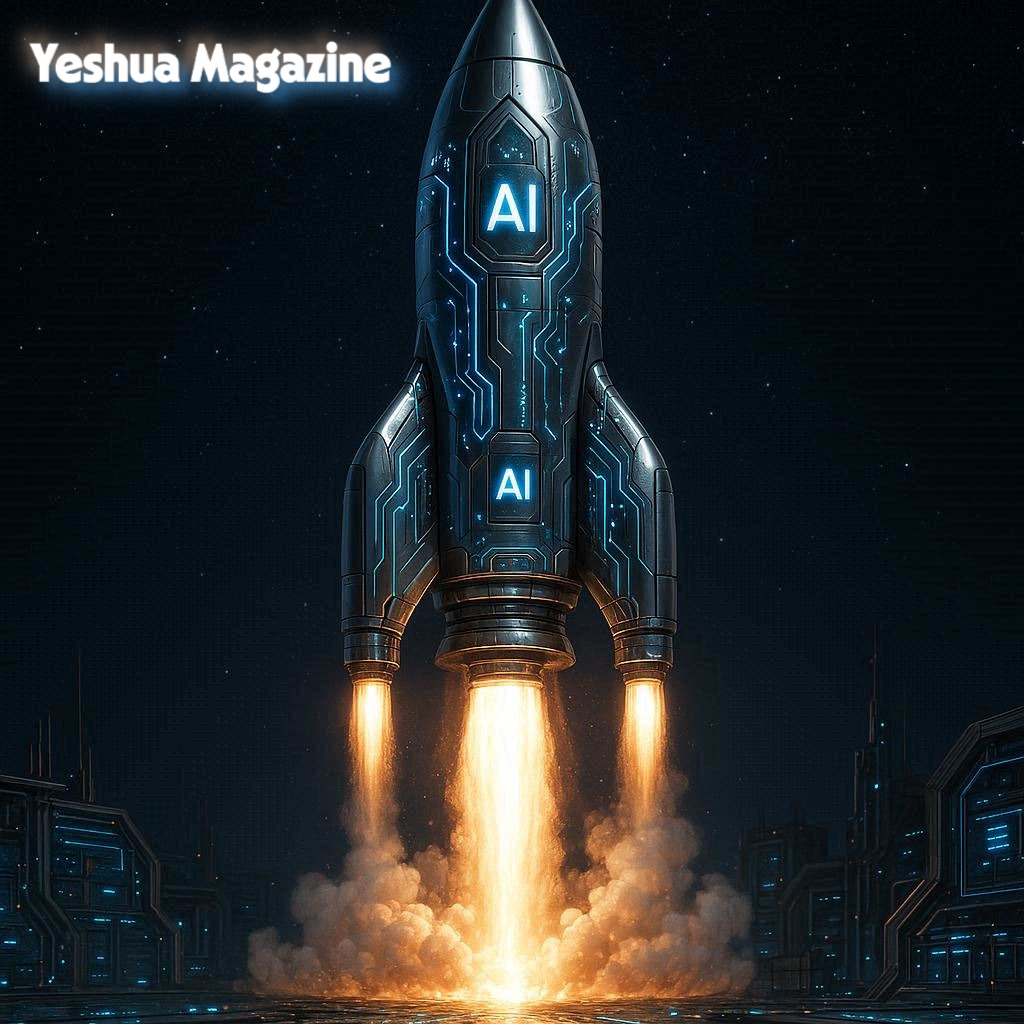


The question of whether artificial intelligence can build space rockets is fascinating. Can AI potentially surpass human capabilities in rocket development? This represents one of the most exciting intersections of technology, engineering, and innovation today.
AI continues to transform countless industries from healthcare to finance. Now, the aerospace sector is experiencing its own revolution. This transformation is fundamentally changing how we design, manufacture, and launch vehicles into space. This comprehensive exploration examines AI’s current role in rocket development. We’ll compare its capabilities versus human expertise and explore what the future holds.
The Current State of AI in Rocket Development
Artificial intelligence is already deeply embedded in modern rocket design. It’s not a distant future concept. Leading space companies are leveraging AI technologies across multiple dimensions. These companies include SpaceX, Blue Origin, NASA, and numerous private aerospace firms.
Machine learning algorithms currently optimize rocket engine designs. They run thousands of simulations that would take human engineers years to complete manually. These AI systems analyze vast datasets from multiple sources. These include previous launches, material stress tests, and atmospheric conditions. The goal is to identify optimal configurations that maximize efficiency while minimizing weight and fuel consumption.
Generative design has revolutionized component manufacturing. This is an AI-driven process. Engineers input design parameters and constraints. These include weight limits, stress tolerances, and material properties. AI then generates hundreds or thousands of potential designs. Some of these AI-generated solutions feature organic, unconventional shapes. Human engineers might never conceptualize these designs. Yet they perform exceptionally well under testing conditions.
SpaceX’s Starship program utilizes AI for rapid prototyping and iterative testing. Machine learning models predict potential failure points before physical testing. This saves millions in development costs. It also accelerates the design cycle. NASA’s Jet Propulsion Laboratory employs similar approaches. They use AI to optimize trajectory planning and fuel efficiency for deep space missions.
Where AI Excels Beyond Human Capabilities
Artificial intelligence demonstrates clear superiority in several critical aspects of rocket development.
Computational Speed and Complexity: AI processes millions of calculations per second. It analyzes aerodynamic properties, structural integrity, and thermal dynamics simultaneously. A task requiring a team of engineers several weeks can be completed in hours or minutes. This computational advantage allows for exploring design spaces far beyond human capacity.
Pattern Recognition Across Massive Datasets: Modern rockets generate terabytes of telemetry data during each launch. AI excels at identifying subtle patterns and correlations within this data. Humans might miss these insights. These discoveries lead to incremental improvements in performance, safety, and reliability.
Optimization Without Bias: Human engineers inevitably carry cognitive biases. These are shaped by education, experience, and industry conventions. AI approaches problems without preconceptions. It often discovers counterintuitive solutions that challenge traditional aerospace engineering wisdom. This fresh perspective has led to breakthrough innovations. These include advances in nozzle geometry, fuel mixture ratios, and structural configurations.
Tireless Iteration: AI systems never experience fatigue, mental blocks, or diminished creativity. They can run optimization cycles continuously, around the clock. They refine designs through millions of iterations. This relentless improvement process accelerates innovation timelines significantly.
Materials Science Innovation: AI algorithms are discovering novel material combinations and alloys. These are specifically optimized for space environments. By analyzing atomic structures, AI predicts material behavior under extreme conditions. It identifies materials with superior strength-to-weight ratios. These materials offer better heat resistance and durability compared to traditional aerospace materials.
Where Humans Remain Indispensable
Despite AI’s impressive capabilities, human expertise remains essential.
Intuition and Creative Problem-Solving: Unexpected challenges always arise in aerospace. Human engineers apply intuition and lateral thinking to devise innovative solutions. They also draw on cross-disciplinary knowledge. AI operates within defined parameters and training data. Humans can think beyond these boundaries when necessary.
Ethical and Safety Judgment: Certain decisions require human judgment. These include acceptable risk levels, safety margins, and mission priorities. Such decisions must be informed by values, ethics, and social responsibility. AI can calculate probabilities. However, humans must decide what risks are acceptable and for whom.
Physical Manufacturing and Assembly: AI can design components brilliantly. However, physical construction still requires skilled human technicians. The tactile feedback, visual inspection, and adaptive problem-solving needed during assembly remain largely human domains. Robotics is gradually augmenting these capabilities.
Systems Integration Understanding: Rockets are extraordinarily complex systems. Thousands of components must work in perfect harmony. Experienced human engineers possess holistic understanding. They know how changes in one subsystem affect the entire vehicle. This systems-thinking perspective prevents problems. It helps avoid optimizing individual components in ways that might compromise overall performance.
Regulatory Navigation and Stakeholder Communication: Gaining approval from regulatory bodies requires human skills. So does communicating with investors and managing public expectations. These tasks require interpersonal skills, political awareness, and communication abilities. AI cannot replicate these capabilities.
The Collaborative Future: Human-AI Partnership
The most promising path forward isn’t AI replacing humans. It’s also not humans rejecting AI. Rather, it’s a collaborative partnership leveraging each party’s strengths. This hybrid approach is already producing remarkable results.
NASA’s Evolutionary Algorithm has worked alongside human engineers. Together they design antenna systems and spacecraft components. These outperform human-only designs. Engineers provide high-level requirements and constraints. AI generates innovative solutions. Humans then evaluate, refine, and implement the most promising options.
This collaborative model addresses a critical limitation. AI lacks the contextual understanding and judgment to independently make final design decisions. However, AI can expand the solution space. Humans then apply wisdom and experience to select optimal approaches. The combination exceeds what either could achieve alone.
Machine learning is also revolutionizing quality control and testing. AI-powered visual inspection systems detect microscopic flaws. They find issues in welds, composite materials, and electronic components. Their accuracy exceeds that of human inspectors. During testing, AI monitors thousands of sensor readings simultaneously. It identifies potential issues before they become critical failures.
AI-Driven Manufacturing Innovations
Artificial intelligence is transforming how rockets are physically built. This goes beyond design. Additive manufacturing, commonly known as 3D printing, is revolutionizing rocket component production. When combined with AI optimization, the results are impressive.
Advanced aerospace companies use massive metal 3D printers. These are guided by AI algorithms to manufacture entire rocket structures. AI-optimized designs minimize part count. They reduce manufacturing time dramatically. Costs are lower compared to traditional fabrication methods.
AI manages the complex variables in 3D printing. These include temperature, material flow rates, layer adhesion, and structural integrity. It achieves precision impossible for human operators. The result is components that are lighter and stronger. They’re also produced in a fraction of the time required by conventional manufacturing.
Robotic systems directed by AI handle dangerous tasks. These include working with cryogenic fuels and high-pressure testing. They also manage toxic propellant handling. These systems improve worker safety. They maintain consistent quality standards that fluctuate with human fatigue or attention lapses.
Predictive Maintenance and Launch Operations
AI’s impact extends beyond building rockets. It also transforms operating and maintaining them. Predictive maintenance algorithms analyze sensor data. They examine rocket engines, fuel systems, and structural components. This forecasts potential failures before they occur.
SpaceX’s reusable Falcon 9 rockets rely heavily on AI-driven diagnostics. These work between flights. Machine learning models predict component wear. They optimize refurbishment schedules. They also determine which parts need replacement. This predictive capability is essential for the economic viability of rocket reusability.
During launch operations, AI systems monitor multiple factors. These include weather patterns, air traffic, and vehicle telemetry. They optimize launch windows and adjust flight trajectories in real-time. These systems process information faster than human mission controllers. This enables split-second decisions that improve safety and mission success rates.
Limitations and Challenges of AI in Rocket Building
Despite remarkable progress, significant limitations exist. These prevent AI from independently building space rockets.
Training Data Constraints: AI learns from existing data. However, revolutionary innovations often require thinking beyond historical precedents. Limited data from successful deep space missions constrains AI’s ability. It struggles to optimize for scenarios with sparse examples.
Explainability Problems: Many advanced AI systems operate as “black boxes.” They produce excellent results through processes that even their creators don’t fully understand. In aerospace, understanding failure modes is critical for safety. This lack of transparency raises concerns.
Edge Case Handling: Spaceflight is filled with rare, unpredictable scenarios. AI excels with common patterns. However, unusual situations requiring creative adaptation remain human strengths. Historic space mission crises exemplify this. They show human problem-solving under unprecedented circumstances. Current AI cannot replicate these capabilities.
Physical World Interaction: AI exists primarily in the digital realm. Translating digital designs into physical hardware requires intermediaries. These can be human or robotic. While robotics is advancing rapidly, a gap remains. The distance between virtual optimization and physical realization is still substantial.
Regulatory and Certification Challenges: Aviation and spaceflight regulatory frameworks were built differently. They assume human decision-making and accountability. Integrating AI into safety-critical systems raises questions. These concern liability, certification standards, and acceptable levels of autonomous operation. Many remain unresolved.
The Evolution of AI Capabilities in Aerospace
The trajectory for AI in rocket development points toward increasing integration. Capabilities continue to expand.
Autonomous Design Iteration: AI systems are evolving significantly. They’re moving toward independently iterating through entire design cycles. This spans from initial concept through virtual testing to manufacturing specifications. Human intervention continues to decrease.
AI-Human Augmented Reality Collaboration: Engineers are beginning to work in augmented reality environments. In these spaces, AI presents real-time design alternatives. It shows simulations and optimization suggestions. This happens as humans manipulate virtual rocket components. This seamless collaboration accelerates innovation while maintaining human oversight.
Fully Autonomous Manufacturing Facilities: Lights-out factories are becoming reality. AI-directed robots manufacture, assemble, and test rocket components. They work without human presence. This currently applies to standardized components. However, final integration will likely remain human-supervised.
AI Mission Planning and Execution: Deep space missions may increasingly feature AI systems. These make autonomous decisions about navigation and resource allocation. They may even handle scientific investigation decisions. This becomes important during multi-year journeys. Real-time communication with Earth becomes impractical.
Democratization of Space Access: AI-driven design and manufacturing optimization continues reducing costs. This potentially opens space access to new players. Smaller nations, universities, and private entities can now participate. Previously, they were unable to afford rocket development.
Real-World Examples of AI Success in Aerospace
Several concrete examples demonstrate AI’s transformative impact on rocket development.
Engine Optimization: Machine learning algorithms have redesigned rocket engine injector plates. They create patterns that improve fuel mixing and combustion efficiency. These exceed what human engineers achieved through decades of iterative development.
Structural Design Breakthroughs: AI-generated rocket component designs feature unconventional geometries. These include lattice structures and organic shapes. They reduce weight by up to 30%. Simultaneously, they maintain or improve structural strength.
Launch Schedule Optimization: AI systems analyze weather patterns, orbital mechanics, and payload requirements. They identify optimal launch windows with greater precision than traditional methods. This increases mission success rates and reduces delays.
Anomaly Detection: During test firings and launches, AI monitors sensor arrays. It detects subtle deviations from expected performance. Human operators might miss these. This prevents catastrophic failures before they occur.
Supply Chain Management: AI optimizes the complex logistics of rocket manufacturing. Thousands of specialized components come from global suppliers. AI predicts delays, identifies alternatives, and reduces manufacturing bottlenecks.
The Philosophical Question: Better Than Humans?
Whether AI can build “better” rockets than humans depends on how we define “better.” Let’s consider different perspectives.
If we measure purely by optimization metrics, AI already wins in many areas. These metrics include weight efficiency, fuel consumption, and structural strength-to-weight ratios. AI surpasses human-only approaches.
However, rocket building involves more than optimization. It requires balancing competing priorities. These include cost versus performance and safety versus capability. Innovation must be weighed against proven reliability. These tradeoffs involve value judgments. They remain fundamentally human concerns.
The most accurate answer is simple. AI and humans are better together than either is alone. AI expands the realm of possibility. It explores design spaces humans cannot imagine. It optimizes with superhuman precision. Humans provide purpose, judgment, and ethical grounding. They also contribute adaptive creativity that AI lacks.
Addressing Common Misconceptions
Several myths about AI in rocket development deserve clarification.
Myth: AI Will Replace Aerospace Engineers
Reality: AI augments rather than replaces human expertise. The most successful aerospace programs combine AI computational power with human capabilities. These include creativity, judgment, and systems thinking.
Myth: AI-Designed Rockets Are Untested and Risky
Reality: AI-optimized designs undergo the same rigorous testing protocols. They follow the same standards as traditional designs. In many cases, AI’s ability to simulate millions of scenarios actually reduces risk. It identifies potential failures earlier in development.
Myth: AI Operates Independently in Rocket Design
Reality: Current AI systems require extensive human oversight. They need training and guidance. Engineers define parameters throughout the process. They interpret results and make final decisions during design.
Myth: Traditional Engineering Knowledge Is Obsolete
Reality: AI tools are most effective with proper guidance. Engineers who understand fundamental aerospace principles get the best results. Domain expertise remains crucial. It’s needed for asking the right questions and validating AI-generated solutions.
Skills Engineers Need in an AI-Enhanced Aerospace Industry
The integration of AI into rocket development is reshaping required skills. Aerospace professionals must adapt.
Data Science Literacy: Understanding how to work with AI tools has become essential. Engineers must interpret machine learning outputs. They must provide quality training data.
Interdisciplinary Thinking: Engineers increasingly need broad knowledge. This spans traditional aerospace engineering, computer science, materials science, and data analytics.
Human-AI Collaboration: The ability to effectively partner with AI systems is critical. Engineers must know when to trust AI recommendations. They must also know when to apply human judgment. This is an emerging skill.
Adaptability: AI capabilities evolve rapidly. Engineers must continuously learn new tools, methodologies, and approaches. Relying solely on established practices is no longer sufficient.
Systems-Level Perspective: AI excels at optimizing individual components. However, humans must maintain holistic understanding. They need to see how subsystems interact within the complete vehicle.
Conclusion
Can AI build space rockets? Absolutely. It’s already doing so. However, it works in collaboration with human engineers rather than independently.
Can AI build better rockets than humans alone? In many specific aspects, yes. AI optimizes designs with remarkable efficiency. It identifies patterns and iterates solutions. Its capabilities exceed human limitations in computational tasks.
However, the question itself may be flawed. The future of rocket building isn’t AI versus humans. It’s AI empowering humans to achieve what neither could accomplish alone. As we venture deeper into space, this partnership will only grow stronger. AI handles computational complexity. Humans provide vision, judgment, and purpose.
The rockets that will carry humanity to Mars will be products of collaboration. So will those establishing lunar bases and perhaps eventually reaching other star systems. They’ll be designed, built, and operated through human-AI partnership. This partnership represents something important. It’s not the replacement of human ingenuity. It’s the ultimate amplification of human potential.
This proves an essential truth. The best space explorers aren’t humans or machines. They’re humans and machines working together.
The aerospace industry stands at an exciting inflection point. Artificial intelligence amplifies human potential rather than diminishing it. As these technologies mature and integration deepens, we can expect remarkable rockets. They’ll be safer, more efficient, and more capable than anything previously imagined. This won’t happen because AI replaced human engineers. It will happen because AI empowered them to transcend previous limitations and reach for the stars.