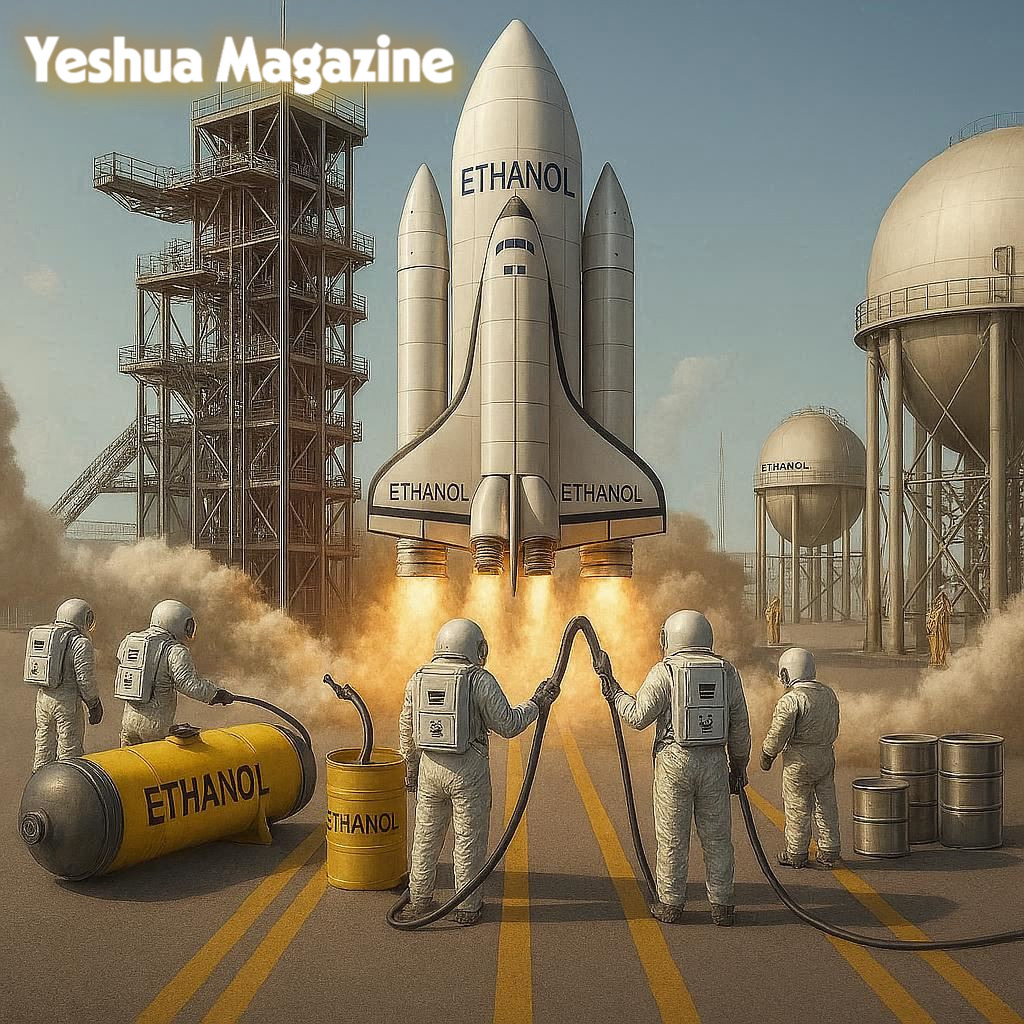


Discover how ethanol could revolutionize space travel with lower costs and environmental impact. Learn about ethanol rocket fuel technology, benefits, challenges, and future applications in this comprehensive guide.
As space exploration costs continue to soar into billions of dollars, scientists and aerospace engineers are constantly searching for more economical and sustainable fuel alternatives. One surprising candidate that has emerged is ethanol—the same alcohol found in beverages and biofuels. But can this readily available substance truly power rockets into space, and could it revolutionize the economics of space travel?
Understanding Ethanol as a Rocket Propellant
Ethanol, chemically known as ethyl alcohol (C₂H₅OH), isn’t just a theoretical rocket fuel—it’s already been used successfully in spaceflight. The potential of ethanol as a rocket propellant lies in its fundamental chemistry. When combined with an oxidizer like liquid oxygen, ethanol combusts at extremely high temperatures, producing the thrust needed to escape Earth’s gravitational pull.
What makes ethanol particularly interesting is its classification as a “green propellant.” Unlike traditional rocket fuels such as hydrazine, which is highly toxic and carcinogenic, ethanol is relatively safe to handle, store, and transport. This inherent safety profile dramatically reduces the precautionary measures and protective equipment required during rocket fueling operations, translating directly into cost savings.
Historical Use of Ethanol in Rocketry
Ethanol isn’t a newcomer to rocket science. During World War II, the German V-2 rocket—the world’s first long-range guided ballistic missile—used a mixture of ethanol and water (75% ethanol, 25% water) as fuel. This historical precedent proved that alcohol-based fuels could generate sufficient power for rocket propulsion.
More recently, several experimental rockets and small satellite launchers have successfully employed ethanol-based fuel systems. Brazil’s space agency has conducted extensive research on ethanol propulsion, leveraging the country’s abundant ethanol production infrastructure from its sugarcane industry. These modern applications demonstrate that ethanol technology has matured beyond its wartime origins into a viable option for contemporary space missions.
The Economic Advantages of Ethanol Rocket Fuel
The potential cost savings of ethanol-based rocket systems are substantial and multifaceted. First, ethanol itself is significantly cheaper than specialized rocket-grade propellants. While rocket-grade kerosene (RP-1) and especially liquid hydrogen require complex refining and handling procedures, ethanol can be produced through well-established industrial processes or even renewable fermentation of biomass.
The infrastructure required for ethanol storage and handling already exists globally due to its use in the automotive and beverage industries. This means rocket facilities wouldn’t need to build specialized containment systems from scratch. Traditional rocket fuels require elaborate safety protocols, hazmat teams, and environmental containment systems. Ethanol’s lower toxicity reduces these requirements dramatically, cutting operational costs by potentially 30-40% according to some aerospace industry estimates.
Furthermore, ethanol can be stored at room temperature and normal atmospheric pressure, unlike cryogenic fuels such as liquid oxygen or liquid hydrogen, which must be kept at extremely low temperatures (below -180°C). The elimination of cryogenic storage requirements removes a massive expense category from rocket operations, including the continuous energy costs of maintaining ultra-cold temperatures and the losses from fuel boil-off.
Performance Considerations and Limitations
While ethanol offers numerous advantages, it’s essential to understand its performance limitations compared to conventional rocket fuels. The specific impulse—a key measure of rocket fuel efficiency—of ethanol is lower than that of liquid hydrogen and slightly lower than kerosene-based fuels. This means that for the same mass of propellant, ethanol produces less total thrust.
For deep space missions requiring maximum efficiency, this performance gap matters significantly. However, for certain applications—particularly small satellite launches, suborbital flights, upper-stage propulsion, and reusable launch vehicle systems—the performance difference becomes less critical, especially when weighed against the substantial cost savings.
The density of ethanol (0.789 g/cm³) falls between that of liquid hydrogen and kerosene, offering a reasonable compromise. Higher density fuels allow for smaller, lighter fuel tanks, which reduces the overall mass of the rocket structure—a crucial consideration in aerospace engineering where every kilogram matters.
Environmental and Sustainability Benefits
Beyond economics, ethanol presents compelling environmental advantages. Bioethanol produced from renewable sources like corn, sugarcane, or cellulosic biomass can be considered carbon-neutral or carbon-negative when accounting for the CO₂ absorbed during plant growth. This stands in stark contrast to fossil fuel-based propellants, which contribute directly to carbon emissions.
The combustion products of ethanol are primarily water vapor and carbon dioxide—far less harmful than the toxic byproducts of hydrazine or nitrogen tetroxide, which can contaminate launch sites and surrounding areas. As environmental regulations become increasingly stringent, the clean-burning nature of ethanol could become not just an advantage but a regulatory necessity.
Current Research and Future Applications
Multiple space agencies and private companies are actively exploring ethanol propulsion systems. Researchers are developing advanced ethanol-based hybrid rockets that combine the fuel with solid oxidizers, creating systems that are even safer and more controllable than traditional liquid-propellant rockets.
The small satellite launch market, which is experiencing explosive growth, represents an ideal testing ground for ethanol propulsion. These launchers don’t require the absolute maximum performance of larger orbital rockets, making them perfect candidates for demonstrating ethanol’s commercial viability. Several startup aerospace companies have announced plans for ethanol-fueled small satellite launchers, with some targeting first flights within the next few years.
For Mars missions and lunar bases, the ability to produce ethanol from local resources presents intriguing possibilities. Ethanol can potentially be synthesized from atmospheric carbon dioxide and water—both of which exist on Mars—using solar-powered chemical processes. This in-situ resource utilization could enable sustainable exploration and reduce the need to transport all propellant from Earth.
Challenges to Widespread Adoption
Despite its promise, several obstacles stand between ethanol and mainstream adoption in space travel. The aerospace industry is inherently conservative, preferring proven technologies with extensive flight heritage. Switching to ethanol would require significant redesign of engines, fuel systems, and operational procedures—a costly proposition that needs clear economic justification.
Engine development presents technical challenges. Ethanol’s combustion characteristics differ from traditional fuels, requiring specialized injector designs and combustion chamber configurations. While these challenges are surmountable, they require substantial research and development investment.
Additionally, the lower energy density means that ethanol-powered rockets may need larger fuel tanks for equivalent missions, potentially offsetting some cost savings with increased structural mass. Engineers must carefully optimize entire rocket designs around ethanol’s specific properties to maximize its benefits.
The Path Forward
The future of ethanol in space exploration likely involves targeted applications rather than wholesale replacement of existing propellants. Ethanol excels in scenarios where cost, safety, and environmental impact outweigh the need for maximum performance. Small satellite launchers, reusable first stages, and orbital maneuvering systems represent promising near-term markets.
As launch cadence increases and space becomes more commercialized, the operational savings from ethanol’s easier handling could become increasingly significant. A spaceport launching hundreds of small satellites annually would benefit enormously from reduced safety protocols and simpler logistics.
Government support for green propellant development could accelerate adoption. Some space agencies have already established programs to incentivize environmentally friendly propulsion technologies, and ethanol fits perfectly within these initiatives.
Frequently Asked Questions (FAQ)
Is ethanol powerful enough to launch rockets into orbit?
Yes, ethanol can generate sufficient thrust to reach orbit, as demonstrated by historical V-2 rockets and modern experimental launches. While it has lower specific impulse than liquid hydrogen, it produces adequate performance for many orbital missions, particularly when combined with liquid oxygen as an oxidizer.
How much cheaper is ethanol compared to traditional rocket fuel?
Ethanol costs significantly less per kilogram than rocket-grade kerosene or liquid hydrogen, with estimates suggesting 40-60% lower fuel costs. However, total mission cost savings depend on many factors including rocket design, operational procedures, and mission requirements. Overall operational savings could reach 30-40% for appropriate applications.
What are the main disadvantages of using ethanol in rockets?
The primary disadvantages include lower specific impulse compared to hydrogen or kerosene, meaning less efficient thrust per unit of fuel. Ethanol also requires engine designs specifically optimized for its combustion characteristics, necessitating development costs. For maximum-performance missions like deep space exploration, these limitations may be prohibitive.
Can ethanol be produced sustainably for space applications?
Absolutely. Bioethanol can be produced from renewable biomass including agricultural waste, algae, and purpose-grown energy crops. This renewable production pathway makes ethanol potentially carbon-neutral and aligns with sustainability goals for future space operations. Some countries already produce bioethanol at industrial scales, providing existing supply chains.
Are any space companies currently using ethanol rockets?
Several aerospace startups and research institutions are developing ethanol-powered rockets, particularly for the small satellite launch market. While no major commercial operators currently use ethanol as their primary propellant, numerous test flights and development programs are underway, with some companies targeting commercial operations within the next few years.
Could ethanol replace all rocket fuels in the future?
Complete replacement is unlikely. Different missions have different requirements, and ethanol works best for specific applications. High-performance deep space missions will likely continue using hydrogen or advanced propellants, while ethanol may dominate cost-sensitive applications like small satellite launches, reusable vehicles, and orbital maneuvering where its advantages in handling, storage, and environmental impact provide maximum benefit.