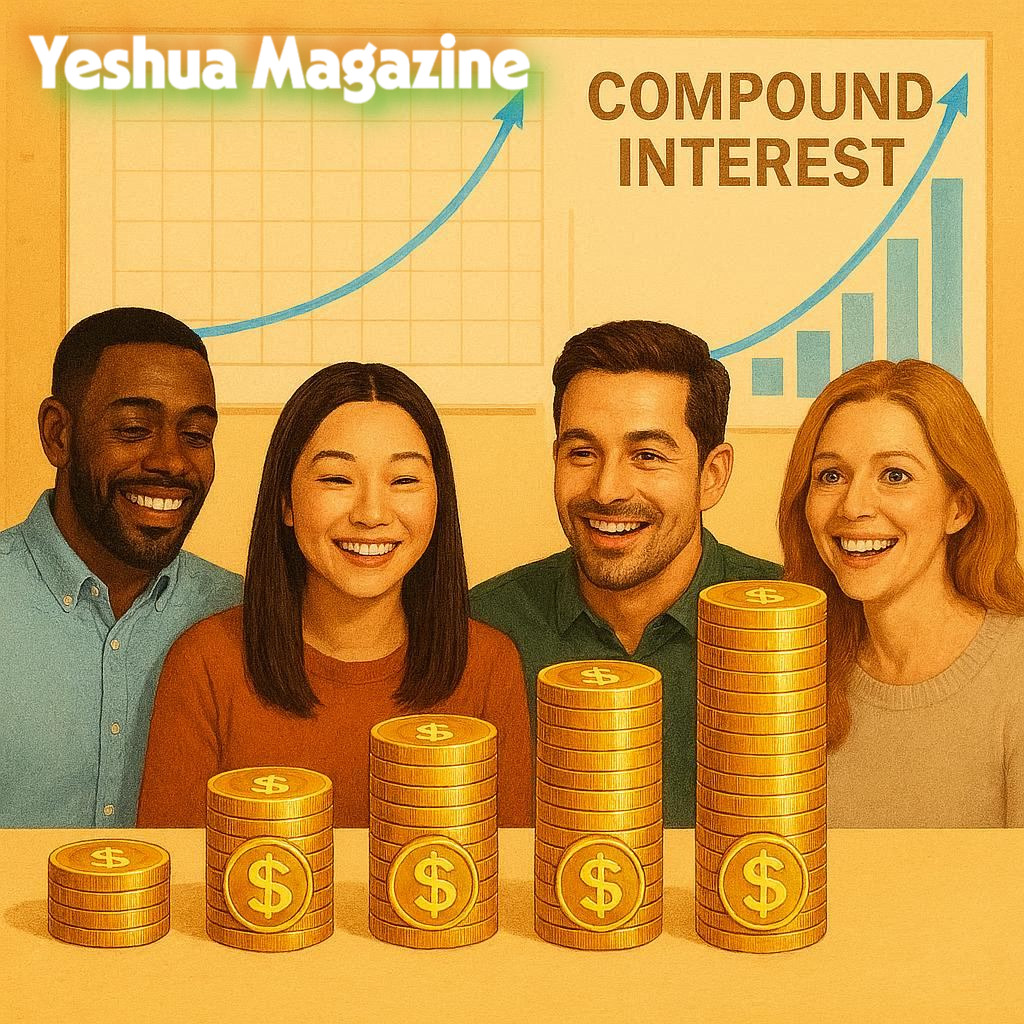


How Compound Interest Makes You Rich: The Ultimate Guide to Growing Wealth Effortlessly
⚠️ Disclaimer: This article is created purely for educational and informational purposes only. It does not constitute financial, investment, or legal advice. The examples, numbers, and scenarios mentioned are illustrative and should not be taken as guarantees of returns. Always consult a qualified financial advisor before making any investment or financial decisions. Past performance of any financial instrument does not guarantee future results.
There is a reason the wealthy keep getting wealthier while many hardworking people struggle to grow their savings. It is not always about how much you earn — it is about understanding one of the most powerful forces in all of personal finance: compound interest.
Attributed to Albert Einstein (though historians debate whether he actually said it), the phrase “compound interest is the eighth wonder of the world” has endured because it captures a truth that most people overlook. Those who understand compound interest earn it; those who do not, pay it. This article will walk you through exactly how compound interest works, why it builds wealth so effectively, and how you can harness its power in your own financial life.
What Is Compound Interest? A Simple Explanation
At its core, compound interest is interest calculated on both the initial principal and the accumulated interest from previous periods. In plain English: your money earns interest, and then that interest itself starts earning interest. It is growth upon growth, snowballing over time.
To understand this better, let us contrast it with simple interest, which is calculated only on the original principal.
Simple Interest Example: You invest ₹1,00,000 at 10% per year. Every year, you earn ₹10,000 in interest — the same flat amount. After 10 years, you have ₹2,00,000 total.
Compound Interest Example: Same ₹1,00,000 at 10%, compounded annually. In Year 1 you earn ₹10,000. In Year 2 you earn 10% on ₹1,10,000, which is ₹11,000. The interest keeps growing. After 10 years, you have approximately ₹2,59,374 — over ₹59,000 more than with simple interest!
The formula for compound interest is:
A = P × (1 + r/n)^(n×t)
Where: A = Final amount | P = Principal | r = Annual interest rate (decimal) | n = Number of times interest compounds per year | t = Time in years
The Three Pillars That Drive Compound Interest
Understanding compound interest requires understanding the three variables that determine how powerfully it works for you:
1. Principal — The Starting Point
Your principal is the initial amount you invest or save. A larger principal naturally generates more interest. However, one of the most encouraging truths about compound interest is that even modest starting amounts can grow into remarkable sums given enough time. You do not need to be wealthy to start — you need to start.
2. Rate of Return — The Engine of Growth
The interest rate or rate of return is the percentage your money earns per period. Even small differences in rate can produce dramatically different outcomes over decades. Consider this: at 6% annual return, money doubles roughly every 12 years. At 9%, it doubles approximately every 8 years. At 12%, it doubles every 6 years. The Rule of 72 is a handy shortcut: divide 72 by your annual rate to find how many years it takes to double your money.
3. Time — The Ultimate Multiplier
Time is perhaps the single most important variable in the compound interest equation. The longer your money stays invested, the more dramatic the compounding effect becomes. This is why financial advisors repeatedly stress: start as early as possible. Even contributing a small amount in your 20s can far outperform a larger amount invested in your 40s.
The Power of Time: A Side-by-Side Comparison
Nothing illustrates the magic of compounding more vividly than a concrete comparison. Let us look at two investors — Priya and Rajan — both aiming to build wealth for retirement at age 60.
| Detail | Priya (Early Starter) | Rajan (Late Starter) |
|---|---|---|
| Starts Investing at Age | 25 | 35 |
| Monthly Investment | ₹5,000 | ₹5,000 |
| Annual Return | 10% | 10% |
| Stops Investing at Age | 60 | 60 |
| Total Years Invested | 35 years | 25 years |
| Total Amount Invested | ₹21,00,000 | ₹15,00,000 |
| Estimated Final Corpus | ₹1.9 crore+ | ₹66 lakh+ |
Priya ends up with nearly three times more wealth than Rajan despite only investing ₹6,00,000 more in total. The difference is time. Those extra 10 years of compounding created an enormous gap. This is the core reason why starting early is not just good advice — it is mathematically transformative.
Compounding Frequency: Why It Matters More Than You Think
Interest does not always compound once a year. Depending on the financial product, compounding can occur annually, semi-annually, quarterly, monthly, weekly, or even daily. The more frequently interest compounds, the more your wealth grows — even at the same stated annual rate.
Example — ₹1,00,000 invested at 10% annual rate for 10 years:
Compounded Annually → ₹2,59,374
Compounded Quarterly → ₹2,68,506
Compounded Monthly → ₹2,70,704
Compounded Daily → ₹2,71,791
The difference might seem small in the early years, but at larger amounts and over longer time horizons, more frequent compounding can add meaningful thousands — or even lakhs — to your final corpus. When comparing financial products, always look at the Effective Annual Rate (EAR) rather than just the stated rate, as EAR accounts for compounding frequency.
Where Does Compound Interest Work for You?
Compound interest is not limited to savings accounts. It operates across a wide range of financial instruments and investment vehicles:
- Fixed Deposits (FDs) and Recurring Deposits (RDs): Traditional bank products that offer guaranteed compound returns, ideal for risk-averse savers.
- Public Provident Fund (PPF): A government-backed savings scheme in India that compounds annually at a declared interest rate, with tax benefits under Section 80C.
- Mutual Funds and SIPs: Systematic Investment Plans (SIPs) in mutual funds allow investors to benefit from both compounding and rupee cost averaging over the long term.
- Equity Investments: Though not guaranteed, equities have historically delivered strong long-term returns. Dividends reinvested into more shares can create powerful compounding effects.
- National Pension System (NPS): A long-horizon retirement product where contributions grow through market-linked compounding over decades.
- Employee Provident Fund (EPF): A mandatory contribution scheme where both employee and employer contributions grow on a compounding basis.
The Dark Side: When Compound Interest Works Against You
Compound interest is a double-edged sword. Just as it can build tremendous wealth, it can also rapidly multiply debt when working against you. Credit card debt is the most common and dangerous example. Credit card companies typically charge interest rates between 24% and 42% per annum. When you carry a balance, interest is added to your outstanding amount, and then next month’s interest is calculated on the new (higher) total.
A credit card balance of ₹50,000 left unpaid at 36% annual interest, with only minimum payments made, can take years to clear and cost multiples of the original amount in interest payments alone. Personal loans, buy-now-pay-later schemes, and payday loans can work similarly when not managed carefully.
The lesson is straightforward: use compound interest as a tool for your savings and investments, and work diligently to avoid it becoming a burden through high-interest debt.
Practical Strategies to Maximize Compound Interest in Your Life
Start Immediately, Not Someday
Every year you delay is a year of compounding lost forever. Even investing a small amount — ₹1,000 or ₹2,000 per month — is infinitely better than waiting until you have a “perfect” amount to invest. Time in the market beats timing the market.
Reinvest All Returns
Whether it is dividends from stocks, interest from bonds, or returns from mutual funds, reinvesting your earnings back into your portfolio rather than withdrawing them keeps the compounding engine running at full power.
Increase Contributions Over Time
As your income grows, increase your investment amount proportionally. Even a modest annual increase of 10% in your SIP contribution can substantially boost your final corpus because each additional rupee benefits from the remaining years of compounding.
Choose the Right Financial Products
Look for instruments with higher compounding frequencies and competitive rates that align with your risk tolerance and financial goals. Compare effective annual rates, not just headline rates.
Minimize Fees and Taxes
Investment fees, fund expense ratios, and taxes eat into your returns and reduce the base on which future compounding occurs. Opting for low-cost index funds and tax-efficient investment vehicles (like ELSS or PPF in India) can preserve more of your compounding gains.
Stay Patient and Avoid Early Withdrawals
Compounding rewards patience above all else. Withdrawing early — whether from a PPF, mutual fund, or FD — not only incurs penalties in many cases but also permanently removes that capital from future compounding cycles. Resist the temptation to dip into long-term savings for short-term needs.
The Psychology of Compound Interest: Why Most People Miss Out
Despite its proven power, the majority of people fail to take advantage of compound interest in a meaningful way. The reason is largely psychological. Human beings are wired to prefer immediate rewards over delayed gratification — a cognitive bias known as hyperbolic discounting. Spending ₹5,000 on something you can enjoy today feels more tangible than investing it for a return you will see three decades from now.
Additionally, the early stages of compounding appear underwhelming. In the first few years, the growth of a modest investment can seem barely noticeable, which discourages continuation. What people fail to anticipate is the exponential curve that emerges later — the phenomenon often called the “hockey stick effect” — where growth accelerates dramatically in the later years of a long investment horizon.
Building wealth through compound interest requires developing financial discipline, setting up automatic contributions so you are not relying on willpower, and keeping a long-term mindset anchored to your eventual goals.
Conclusion: The Wealth-Building Secret Hidden in Plain Sight
Compound interest is not a secret reserved for the financially elite. It is a universal principle available to anyone willing to save consistently, invest wisely, and — most importantly — give it time. Whether you are a student making your first investment, a young professional starting a SIP, or someone in mid-career catching up on retirement savings, the best time to embrace compound interest is now.
The numbers are clear: small, consistent investments made early and left undisturbed can grow into life-changing wealth. The wealthy do not just work for money — they put money to work for them. Compound interest is the mechanism that makes this possible, and it is within your reach today.
Start small if you must. Start now regardless. Let time do the heavy lifting.
📌 Educational Disclaimer: All content in this article is intended solely for educational and informational purposes. The figures, examples, and projections used are hypothetical illustrations to explain financial concepts and do not represent actual investment advice or guaranteed outcomes. Investment in mutual funds, equities, and other financial instruments is subject to market risks. Please read all scheme-related documents carefully and consult a SEBI-registered financial advisor before making any investment decision.