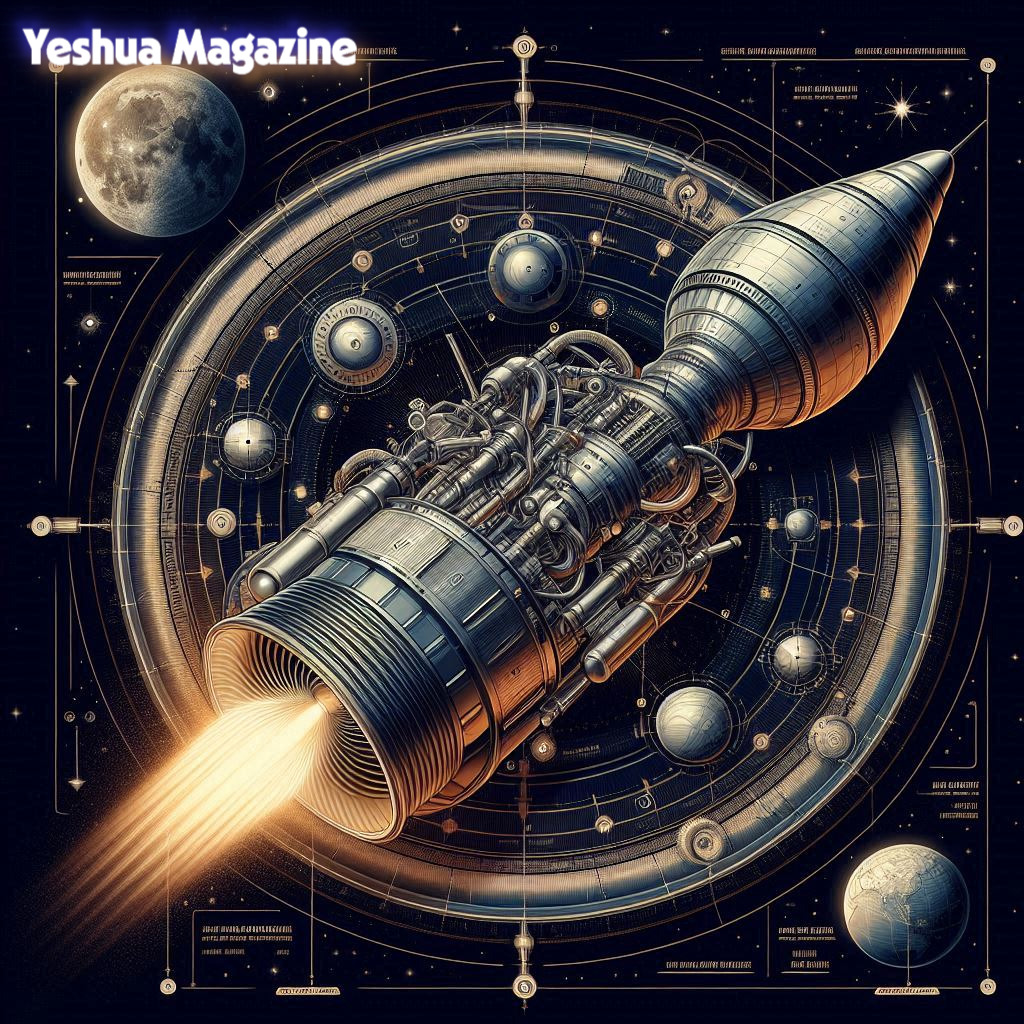


How can rockets move in space with nothing to push against? This guide explains Newton’s Third Law, rocket engine design, orbital mechanics, and future propulsion—all in simple, clear terms. Introduction: Busting the Space Myth
Many think rockets need air to push against. This idea makes space travel seem impossible. However, rockets work perfectly in a vacuum. They operate on a simple law of physics. We will explore how rockets generate thrust, navigate, and reach orbit. By the end, you’ll see why space is their ideal environment.
Part 1: The Core Law of Motion
Understanding Newton’s Third Law
Newton’s Third Law states: “For every action, there is an equal and opposite reaction.” This means forces always come in pairs. For instance, if you push against a wall, the wall pushes back. This principle powers every rocket.
Action and Reaction in Space
Imagine floating in space with a heavy toolbox. Throw the toolbox away from you. You will drift in the opposite direction. You didn’t push against anything external. Your action created a reaction. A rocket works the same way. It throws hot gas backward. Consequently, the gas pushes the rocket forward. This forward push is called thrust.
The Self-Contained System
Rockets carry their own fuel and oxidizer. They combine these to create high-pressure gas. Then, they expel this gas to create thrust. Therefore, they need nothing from the outside. In fact, space’s vacuum helps them work more efficiently.
Part 2: The Rocket Engine Explained
The Fuel: Rocket Propellant
Rockets need both fuel and an oxidizer. The oxidizer provides oxygen for burning. Common types include:
- Liquid propellants like hydrogen and oxygen.
- Solid propellants mixed into a solid mass.
- Hypergolic propellants that ignite on contact.
Each type suits different missions. For example, liquid fuels are efficient. Meanwhile, hypergolic fuels are very reliable.
Where Combustion Happens
Next, fuel and oxidizer enter the combustion chamber. Here, they mix and ignite. The resulting explosion creates extremely hot gas. Temperatures can exceed 3,000°C. This process releases immense energy.
The Nozzle: Harnessing the Energy
The hot gas then rushes into the nozzle. This bell-shaped part is crucial. First, it squeezes the gas through a narrow throat. This speeds the gas to sonic velocity. Then, the expanding bell converts heat into forward motion. As a result, exhaust shoots out at over 10,000 mph. This high-speed ejection maximizes thrust.
Part 3: Precise Control in the Void
The Need for Maneuvering
In space, there’s no air for steering. Spacecraft can’t use wings or rudders. So, they need another system for control.
How Reaction Control Systems Work
Spacecraft use small thrusters called Reaction Control Systems (RCS). These thrusters fire in precise bursts. For example, to turn left, a thruster on the right side fires. This pushes the right side forward. Thus, the craft rotates left. Similarly, other thrusters control rolling and sliding movements.
Applications of RCS
These systems are vital for many tasks. They help dock with space stations. They aim telescopes at new targets. They also position ships for engine burns. Without RCS, precise space travel would be impossible.
Part 4: Reaching and Changing Orbit
Orbit: A Balancing Act
Reaching space is about altitude. However, achieving orbit is about speed. An object must go incredibly fast sideways. Specifically, it needs to reach about 28,000 km/h. At this speed, its fall toward Earth matches the planet’s curve. Therefore, it falls around Earth continuously. This is an orbit.
The Two-Stage Ascent
Rockets launch in two main phases. First, they fly straight up. This quickly clears the thick atmosphere. Then, they tilt and accelerate horizontally. Their goal shifts from climbing to gaining immense sideways velocity.
Moving Between Orbits: The Hohmann Transfer
Changing orbits requires smart planning. The most efficient method is a Hohmann transfer. Here’s how it works:
- The spacecraft fires its engine to speed up. This moves it into an elliptical path.
- It coasts to the farthest point of that ellipse.
- There, it fires the engine again to circularize the new orbit.
This method uses minimal fuel. It’s a cornerstone of orbital mechanics.
Part 5: Advanced Propulsion for Deep Space
Limits of Chemical Rockets
Chemical rockets are powerful but inefficient for long journeys. They burn fuel quickly. For trips to other planets, we need a different solution.
Ion Thrusters: Efficiency Over Power
Ion thrusters use electricity, often from solar panels. They work in three steps:
- Ionization: They strip electrons from a gas like xenon.
- Acceleration: Electric fields accelerate the ions to tremendous speeds—over 89,000 mph.
- Neutralization: Electrons are added back to the exhaust stream.
The Gentle, Continuous Push
The thrust from an ion engine is very faint. However, it can fire continuously for years. Over time, this gentle push builds very high speeds. Consequently, ion thrusters are perfect for unmanned deep-space missions. Probes like NASA’s Dawn and DART used this technology. In the future, they may help crewed missions reach Mars efficiently.
Conclusion: Simplicity Powers Exploration
Rocket science may seem complex. Yet, it relies on a simple, powerful law. Newton’s Third Law—action and reaction—makes spaceflight possible. Rockets move by throwing mass backward. The vacuum of space makes this process even more effective. From roaring launches to silent ion glides, this principle guides us. It allows humanity to explore beyond our home planet.
Frequently Asked Questions
Q: Can a rocket coast in space?
A: Yes. Newton’s First Law says objects in motion stay in motion. A rocket will coast forever unless a force acts on it.
Q: Why do rockets have stages?
A: Staging drops empty fuel tanks. This makes the rocket lighter. As a result, the engines can accelerate the remaining mass more effectively.
Q: How do spacecraft land on airless worlds?
A: They use their engines to slow down. By firing in the opposite direction of travel, they kill their speed for a soft landing.