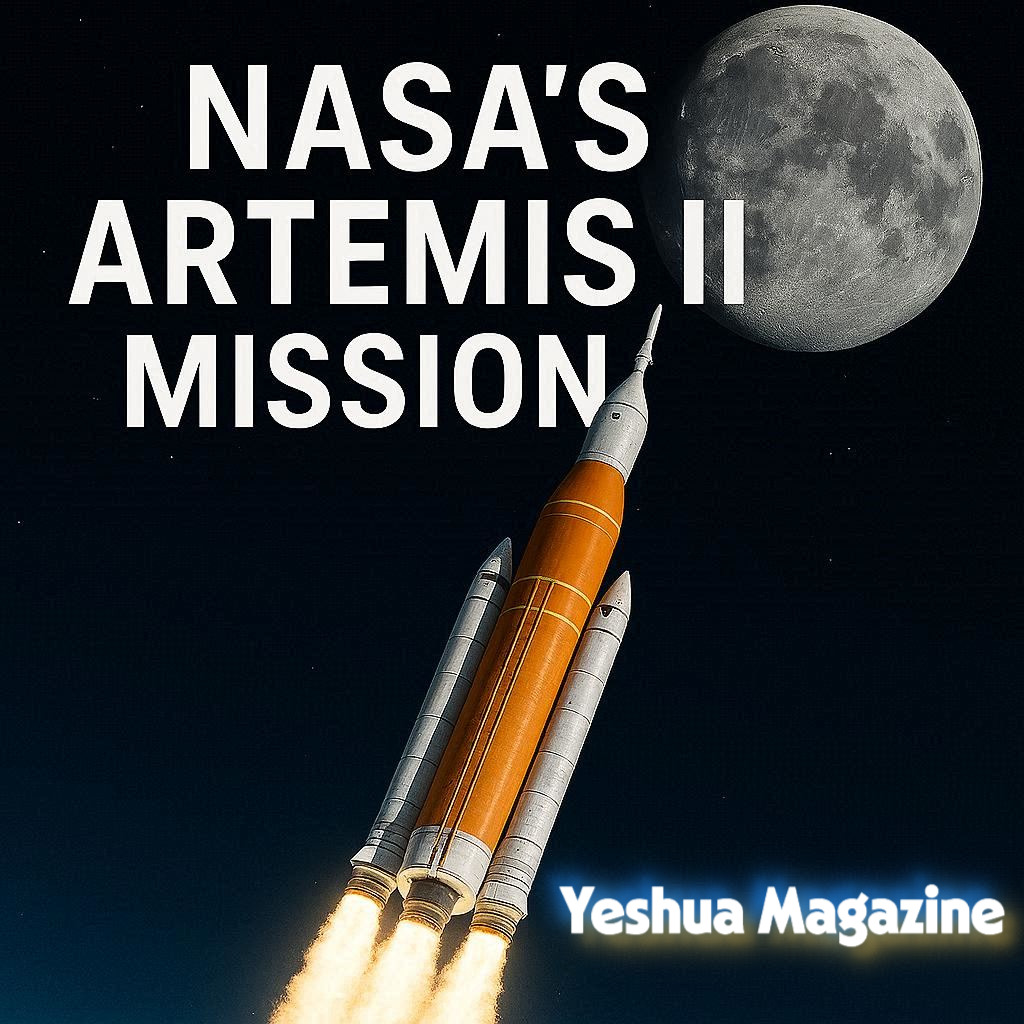


The most significant crewed space mission in over 50 years is finally about to launch — here is everything you need to know.
Introduction: A New Chapter in Space Exploration
For over five decades, the Moon has existed as a distant dream rather than a reachable destination. The last time human beings set foot on the lunar surface was during the Apollo 17 mission in December 1972. Since that historic moment, no crewed spacecraft has ventured beyond low Earth orbit. That long era of absence is now coming to a dramatic end. NASA’s Artemis II mission is scheduled to launch no earlier than February 8, 2026, from Kennedy Space Center in Florida. It will carry four astronauts on a ten-day journey around the Moon and back to Earth, marking the first time in over fifty years that human beings have traveled to the vicinity of our closest celestial neighbor.
Artemis II is not simply a repeat of what came before. It represents a fundamentally different vision of space exploration — one built on international collaboration, cutting-edge technology, and the long-term goal of establishing a permanent human presence on the Moon. This mission is the critical bridge between robotic exploration and actual crewed lunar landings, and it will set the stage for everything that follows in humanity’s journey back to the stars.
| 10 Days In Space | 4 Crew Members | 54 Years Since Apollo |
What Exactly Is the Artemis II Mission?
Artemis II is the second mission in NASA’s broader Artemis program, which is designed to take humanity back to the Moon and eventually on to Mars. The first mission, Artemis I, was an uncrewed test flight that successfully launched in November 2022. That mission sent the Orion spacecraft on an orbit around the Moon and back to Earth without any astronauts aboard. Its purpose was purely to test the Space Launch System rocket and the Orion capsule as an integrated system under real deep-space conditions. The mission was a resounding success, traveling over 2.3 million kilometers before splashing down safely in the Pacific Ocean.
Artemis II builds directly on that foundation. This time, four astronauts will be seated inside the Orion spacecraft as it lifts off atop the massive Space Launch System rocket. The crew will not land on the Moon. Instead, Orion will follow what is known as a free-return trajectory — a carefully calculated path that uses the Moon’s gravitational pull to swing the spacecraft around its far side and send it back toward Earth without requiring a powered landing maneuver. The journey to the Moon will take approximately three days. Once there, the astronauts will spend roughly one day observing the lunar surface, including portions of the far side that have rarely been seen up close by any human eye.
The primary objective of the mission is to verify that all of Orion’s onboard systems — life support, navigation, communication, and emergency protocols — function correctly with a live crew in the harsh environment of deep space. NASA must confirm that the spacecraft can safely sustain human beings far beyond the protective bubble of Earth’s atmosphere before committing to any surface landing missions in the future.
Meet the Crew: Four Pioneers Making History
The Artemis II crew is not just a group of skilled professionals. Each member carries historic significance. This mission will see multiple firsts achieved simultaneously, redefining who gets to explore the cosmos.
Reid Wiseman
Mission Commander
A decorated U.S. Navy captain and engineer, Wiseman previously spent 165 days aboard the International Space Station in 2014. He served as NASA’s Chief of the Astronaut Office and brings deep leadership experience to this high-stakes flight.
Victor Glover
Pilot
A former Navy test pilot and accomplished astronaut, Glover flew on the SpaceX Crew-1 mission in 2020. On Artemis II, he will become the first person of color to travel to the Moon.
Christina Koch
Mission Specialist
An electrical engineer who holds the record for the longest single spaceflight by a woman at 328 days, Koch participated in the first all-female spacewalk. She will become the first woman to travel to the Moon.
Jeremy Hansen
Mission Specialist
A former Royal Canadian Air Force fighter pilot and a Canadian Space Agency astronaut, Hansen will become the first non-American citizen to travel to the Moon. Artemis II is his first spaceflight.
The Technology Behind Artemis II
The two machines at the heart of this mission are the Space Launch System (SLS) rocket and the Orion spacecraft. The SLS is one of the most powerful rockets ever built. It stands taller than the Statue of Liberty and generates an enormous amount of thrust during launch, propelling Orion beyond Earth orbit and onto its path toward the Moon. The rocket uses a core stage powered by four RS-25 engines — the same engines originally designed for the Space Shuttle — along with two massive solid rocket boosters that provide the bulk of the initial thrust before separating roughly two minutes after liftoff.
Orion is a capsule-style spacecraft designed to withstand the extreme conditions of deep space travel. It must protect its crew from intense radiation, maintain breathable air and stable temperatures, and survive a violent reentry back into Earth’s atmosphere at speeds approaching 25,000 miles per hour. During reentry, Orion will employ a unique skip reentry technique, briefly dipping into the upper atmosphere to shed heat and then bouncing back out before making a final descent. This method allows for a more controlled and precise splashdown in the Pacific Ocean near San Diego.
One of the more notable upgrades over the Apollo era is Orion’s life support system. The crew will test air recycling, water management, and carbon dioxide removal systems that must function flawlessly over the course of the entire mission. For the first time in history, astronauts will also test a deep-space toilet system — a significant technological advancement compared to the primitive solutions used during the Apollo program decades ago.
Why Does This Mission Matter So Much?
On the surface, flying around the Moon without landing might seem like a modest achievement compared to what Apollo accomplished in the late 1960s and early 1970s. But the significance of Artemis II extends far beyond its immediate objectives. Sending human beings beyond low Earth orbit is extraordinarily difficult, expensive, and politically demanding. It requires sustained funding, reliable technology, and consistent political commitment over many years. A crewed mission sends a powerful signal — to international partners, to commercial space companies, and to the world — that NASA is serious about returning to the Moon permanently.
Artemis II is also the gateway to everything that comes next. The successful completion of this mission will pave the way for Artemis III, which is planned to actually land astronauts on the lunar surface for the first time since Apollo 17. Beyond that, future Artemis missions will work toward constructing a space station called the Lunar Gateway in orbit around the Moon, establishing a base on the lunar surface, and ultimately using the Moon as a launching pad for crewed missions to Mars. The Artemis program now includes more than 60 nations signed onto the Artemis Accords, making it one of the largest international space cooperation efforts in history.
The Road Ahead: From Flyby to Moon Landing
Artemis I (November 2022) — Completed
Uncrewed test flight of SLS and Orion. Successfully orbited the Moon and returned to Earth after traveling 2.3 million kilometers.
Artemis II (February 2026) — Upcoming
First crewed lunar flyby. Four astronauts will travel around the Moon on a free-return trajectory over ten days.
Artemis III (Mid-2027 or later) — Planned
First crewed Moon landing since Apollo 17. Two astronauts will walk on the lunar South Pole using a SpaceX Starship lander.
Artemis IV & Beyond (2028–2030+) — Future
Construction of the Lunar Gateway station, permanent surface habitats, and laying the groundwork for eventual crewed missions to Mars.
Conclusion: The Dawn of a New Era
Artemis II is more than a space mission. It is a statement about who we are and where we want to go as a species. After more than half a century of absence, human beings are once again preparing to leave the safety of Earth and venture toward the Moon. The four astronauts aboard Orion will carry with them the hopes and curiosity of billions of people around the world. Their journey will test the boundaries of modern engineering, push the limits of human endurance, and open the door to a future in which the Moon is not just a destination we visit, but a place where we live and work.
Whether Artemis II launches on February 8 or shifts by a few days due to weather or technical checks, the outcome remains the same. Humanity is headed back to the Moon. And this time, we are not planning to leave anytime soon.