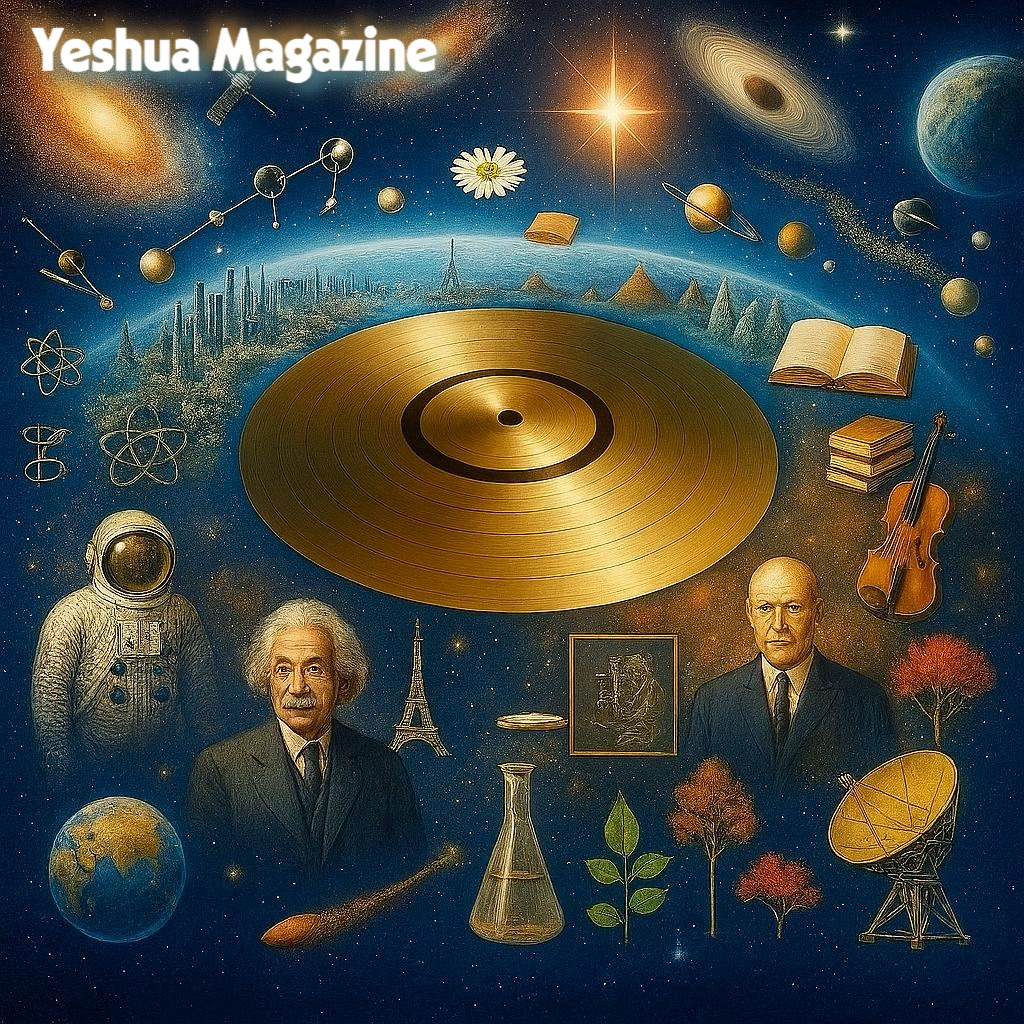


Introduction: A Time Capsule Cast into the Cosmic Ocean
In 1977, humanity did something unprecedented. We launched two spacecraft that would leave our solar system forever. Attached to each was a golden phonograph record. These were not just technical manuals. They were bottles cast into the cosmic ocean. Their message was simple: this is who we are.
The Voyager 1 and 2 probes carry these “Golden Records.” They are our first deliberate messages to the stars. The records contain sounds, music, and images from Earth. They tell a story of our planet, our culture, and our humanity. Their audience might be an alien civilization millions of years in the future. Or they may drift forever in silence. But their purpose is eternal: to speak for us when we are gone.
Part 1: The Audacious Project – Creating a Message for Eternity
The Vision of Carl Sagan
Astronomer Carl Sagan led the team that created the Golden Record. NASA gave him a monumental task. Create a message that represents all of humanity. Make it understandable to a being with no shared language, biology, or senses. And make it last for a billion years.
Sagan assembled a diverse committee. It included artists, musicians, scientists, and philosophers. Their goal was not to show off technology. It was to convey the essence of life on Earth.
Engineering for Deep Time
The record itself is a marvel of durability. It is made of copper, plated with gold, and sealed in an aluminum jacket. Etched on the cover are symbolic instructions for playback. The record is designed to survive in the vacuum of space for over a billion years.
The team chose a phonograph record for a specific reason. It is analog and physical. An advanced civilization could decipher its grooves, even if the concept of “sound” was foreign to them. The record spins at 16 ⅔ revolutions per minute. A cartridge and needle are included in the spacecraft, with symbolic instructions on how to use them.
Part 2: Decoding the Cover – A Universal Instruction Manual
The record’s aluminum cover is a Rosetta Stone for aliens. It uses the most universal language we know: science and mathematics.
The Pulsar Map: Our Cosmic Address
The most important diagram is a pulsar map. It shows the location of our Sun relative to 14 pulsars. Pulsars are spinning neutron stars. They emit radio waves with extreme regularity, like cosmic lighthouses.
Each pulsar’s “fingerprint” is shown in binary code. This represents its unique spin rate. By comparing these rates to what they observe, an alien civilization could triangulate our Sun’s position. They could trace back Voyager’s origin point, even millions of years after launch. The map also shows the hyperfine transition of neutral hydrogen. This is the most common element in the universe. It acts as a universal ruler for units of time and distance.
The Playback Instructions
Silhouettes show the record, needle, and correct playback speed. A diagram traces the first sound waveform in the recording. It shows a video signal that becomes the first image. These instructions use physics, not language.
Part 3: The Sounds of Earth – A Planet’s Audio Diary
Side one of the record holds 115 analog-encoded images. Side two contains sounds. The sound selection aims to tell a story of Earth’s daily life and natural history.
The Natural World
- Whale Song: The haunting, complex calls of the humpback whale. It shows intelligent life that is not human.
- The Sounds of Weather: Thunder, wind, and rain. These convey the dynamic atmosphere of a living world.
- Volcanoes, Earthquakes, and Mud Pots: The geological voice of an active planet.
- Animal Calls: Birds, dogs, sheep, and chimpanzees. A sample of Earth’s biological chorus.
Human Activity and Emotion
- Footsteps and Heartbeats: The simple, organic rhythms of a human body.
- Laughter: A pure expression of joy, untranslatable but universally human.
- A Mother’s Kiss: An intimate sound of care and connection.
- Tools and Technology: The sound of a saw, a hammer, a Morse code message, and the rumble of a Saturn V rocket launch. It traces human progress from simple tools to spaceflight.
Part 4: The Music of the Spheres – Earth’s Greatest Hits
The record includes 90 minutes of music from around the world. The selection avoids popular “hits” of the 1970s. Instead, it seeks pieces that express deep human emotion and cultural identity.
The Global Playlist
- Bach, Brandenburg Concerto No. 2: Chosen for its complex, mathematical beauty—a “music of the spheres.”
- Beethoven, Symphony No. 5: A powerful expression of struggle and triumph.
- Stravinsky, The Rite of Spring: Represents the rhythmic, primal energy of humanity.
- Chuck Berry, “Johnny B. Goode”: The sole inclusion of rock and roll. Sagan fought for it, arguing that a vital part of 20th-century humanity shouldn’t be ignored.
- Senegal Percussion: The driving, communal rhythm of West African drums.
- Navajo Night Chant: A spiritual, haunting vocal piece from Native American tradition.
- “Flowing Streams” (China): A piece for the guqin, one of the world’s oldest instruments, representing meditative calm.
- “Melancholy Blues” by Louis Armstrong: The soulful, improvisational voice of jazz and human sorrow.
This playlist is a statement: Humanity is not a monolith. We are a chorus of diverse voices, united by our capacity to create beauty.
Part 5: The Greetings – “Hello” in 55 Human Tongues
Before the music, the record carries spoken greetings in 55 languages. They range from ancient tongues like Akkadian and Hittite to modern English and Mandarin.
Each greeting is a cultural snapshot:
- English: “Hello from the children of planet Earth.”
- Welsh: “Good health to you now and forever.”
- Portuguese: “Peace and happiness to all.”
Some are playful, some formal, all profoundly human. They are followed by a special “greeting” from then-UN Secretary-General Kurt Waldheim and a “thought” from President Jimmy Carter.
Carter’s message encapsulates the record’s spirit: “We cast this message into the cosmos… a present from a small, distant world: our sounds, our science, our images, our music, our thoughts and our feelings. We are attempting to survive our time so we may live into yours.”
Part 6: The 115 Images – A Visual Encyclopedia of Earth
Encoded in the record’s grooves are 115 photographs and diagrams. They were painstakingly selected to build a visual understanding of our world.
The Tutorial Images
The first images are scientific. They define our scales: a circle to show binary numbers, diagrams of DNA structure, our Solar System, and human anatomy. They build a visual vocabulary.
The Story of Life and Humanity
The images then unfold like a storybook:
- Our Planet: Images of Earth from space, landscapes, mountains, and oceans.
- Life in All Its Forms: From cells under a microscope to ferns, trees, animals, and insects.
- The Human Body: Diagrams and photos showing human form, anatomy, reproduction, and stages of life from fetus to old age.
- Human Society: Scenes of eating, working, learning, and playing. Images of architecture from huts to the Taj Mahal and the Great Wall.
- Science and Technology: From a simple lever to telescopes, airplanes, and a radio telescope. It shows our quest to understand the universe.
- The Final Image: A simple, beautiful photograph of a sunset. A quiet, poignant end to the visual journey.
Part 7: The Philosophical Legacy – What Does the Record Say About Us?
The Golden Record is more than a collection of data. It is a philosophical document. It reflects the hopeful, idealistic side of the 1970s space age.
The Optimistic Assumptions
The record makes bold assumptions:
- That intelligence implies curiosity and benevolence.
- That science and mathematics are universal languages.
- That beauty and emotion are concepts other beings might recognize or value.
What We Chose to Omit
The record is also defined by what it leaves out. There is no mention of war, poverty, disease, or environmental destruction. Sagan’s team made a conscious choice. They presented an aspirational version of humanity. They showed the best of what we are, in hope of who we might become.
This choice has been debated. Is it dishonest? Or is it a necessary act of hope, casting our ideals into the future?
Part 8: The Journey Ahead – Where Are the Voyagers Now?
The Loneliest Spacecraft
As of now, Voyager 1 is over 24 billion kilometers from Earth. It is in interstellar space, beyond the Sun’s protective magnetic bubble. Voyager 2 has also crossed this frontier. They are the farthest human-made objects in existence.
Their nuclear power sources are fading. By 2030, their last instruments will fall silent. They will become ghost ships, drifting among the stars.
A Message with No Guarantee
The chance that the records will ever be found is infinitesimally small. Space is vast and mostly empty. Yet, as Sagan said, “The launching of this bottle into the cosmic ocean says something very hopeful about life on this planet.”
The act of sending the message was the real achievement. It forced us to see ourselves as a single community on a pale blue dot. It was an act of profound unity and hope.
FAQs: Your Questions About the Golden Record
Q1: Could aliens actually play the record?
A: The instructions are based on universal physics (pulsar timing, hydrogen transition). A technologically advanced civilization could likely decode the cover symbols. Playing the record itself would require understanding analog audio and 2D images, which is a bigger leap, but perhaps not impossible for a curious intelligence.
Q2: Why wasn’t any modern pop music included?
A: The committee wanted timeless pieces that represented cultural depth, not fleeting trends. Chuck Berry’s inclusion was controversial but seen as vital for representing a major 20th-century art form.
Q3: Are the Voyagers headed toward any stars?
A: In about 40,000 years, Voyager 1 will drift within 1.6 light-years of a star in the constellation Camelopardalis. Voyager 2 will pass near Sirius in 296,000 years. “Close” in space terms still means trillions of kilometers away.
Q4: Has anyone made a more recent interstellar message?
A: Yes, but none as famous. The New Horizons probe to Pluto carries a less elaborate message. Private initiatives like “The Last Pictures” and “Lunar Mission One” have continued the tradition. The Golden Record remains the most comprehensive and philosophical effort.
Q5: What would you put on a Golden Record today?
A: This is the record’s greatest legacy—it makes us ask this question. Today, we might include digital files, video, internet data, or updates on climate change and global connectivity. The question forces us to consider: How has humanity changed since 1977? What defines us now?
Q6: Was it risky to send our location into space?
A: This “risk” is scientifically negligible. The records will take tens of thousands of years to approach another star system. Any civilization capable of interstellar travel would have already detected our planet’s biosignatures (like oxygen in our atmosphere) from light-years away.
Conclusion: A Testament to Hope
The Golden Records are not just messages for aliens; they are a mirror held up to humanity. This cosmic time capsule shows us at our most ambitious, creative, and hopeful. Ultimately, it represents a moment when we looked beyond our divisions, seeing ourselves as citizens of a single planet with a story worth telling to the cosmos.
The Voyagers will outlast Earth. When the Sun expands and engulfs our world in billions of years, these two artifacts may still be intact. Drifting in the galactic dark, they will carry the essence of a species that once lived, wondered, and reached for the stars.
Their message is simple, timeless, and profound: We were here.