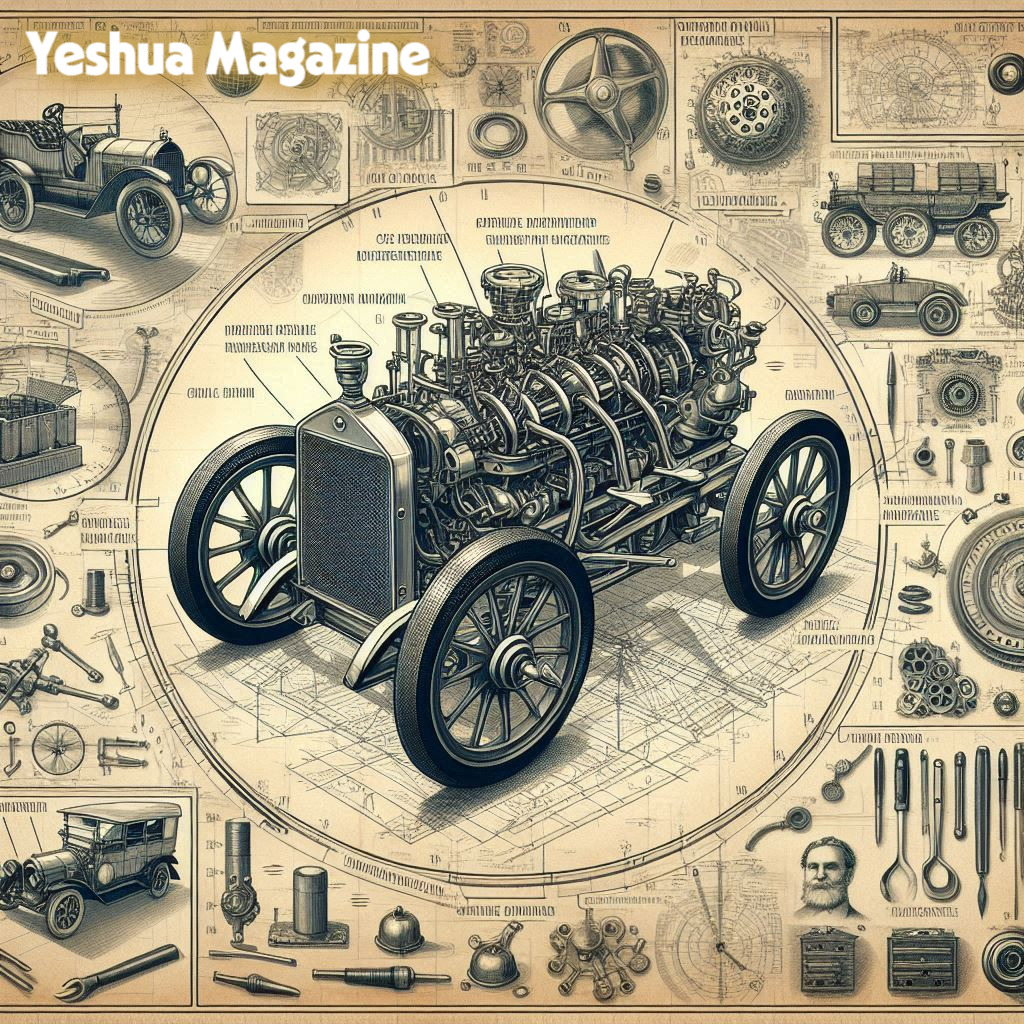


Discover the true inventors behind the car engine, from early steam concepts to the revolutionary internal combustion engine that changed the world forever.
Introduction: The Quest for Automotive Power
The invention of the car engine is not the story of a single “Eureka!” moment but a fascinating journey of incremental breakthroughs spanning centuries. When we ask, “Who invented the car engine?” we must look beyond popular myths to the collaborative efforts of visionaries, engineers, and tinkerers who paved the way for the modern automobile. This article explores the key figures and innovations that transformed the dream of self-propelled vehicles into reality.
Early Foundations: Steam Power and Predecessors
Long before gasoline engines, inventors experimented with steam-powered vehicles. In the 17th century, Ferdinand Verbiest, a Flemish Jesuit missionary in China, designed a rudimentary steam-powered carriage for the Chinese emperor—though it was more a curiosity than a practical vehicle.
The Rise of Steam Locomotion
By the late 18th century, steam-powered road vehicles emerged in Europe. Nicolas-Joseph Cugnot’s 1769 steam-powered artillery tractor is often cited as the first true automobile. However, these early machines were bulky, inefficient, and limited by the technology of their time. Steam engines relied on external combustion, requiring massive boilers and frequent stops for water and fuel, making them impractical for widespread personal transportation. This era proved the concept of mechanical propulsion but highlighted the need for a more compact and efficient power source.
The Dawn of Internal Combustion: Key 19th-Century Innovations
The real breakthrough came with the internal combustion engine (ICE), which burns fuel inside a chamber to generate motion. This shift ignited a race to create a practical power unit for vehicles.
Étienne Lenoir (1860): The First Practical ICE
Belgian engineer Étienne Lenoir built the first commercially successful internal combustion engine in 1860. His engine used coal gas and air, ignited by an electric spark—a concept foundational to later designs. Though inefficient and noisy, Lenoir’s engine powered vehicles, boats, and machinery, proving that internal combustion was a viable alternative to steam.
Nicolaus Otto (1876): The Four-Stroke Revolution
German engineer Nicolaus Otto perfected the four-stroke engine (intake, compression, power, exhaust), known as the “Otto cycle.” His 1876 engine was quieter, more efficient, and reliable than Lenoir’s, and it ran on liquid petroleum for the first time. Otto’s design became the blueprint for modern gasoline engines, though he initially focused on stationary applications rather than vehicles.
Karl Benz (1885): Integrating Engine and Automobile
While Otto improved the engine, Karl Benz was the first to combine a lightweight four-stroke gasoline engine with a purpose-built vehicle. In 1885, Benz patented the Benz Patent-Motorwagen, a three-wheeled vehicle powered by a single-cylinder, 0.75-horsepower engine. This is widely regarded as the first true automobile designed from the ground up. Benz’s genius lay in systems integration: he invented the carburetor, ignition system, and radiator to make his engine practical for road use.
Gottlieb Daimler and Wilhelm Maybach (1885): High-Speed Engine Innovation
Concurrently, German engineers Gottlieb Daimler and Wilhelm Maybach developed a compact, high-speed gasoline engine (600 RPM, versus Benz’s 250 RPM). Their 1885 “Grandfather Clock” engine was lightweight and powerful enough to propel vehicles at unprecedented speeds. In 1886, they installed it in a stagecoach, creating the first four-wheeled gasoline automobile. Daimler and Maybach’s work later gave rise to the Mercedes-Benz brand.
The “First” Controversy: Benz vs. Daimler
Historians often debate whether Benz or Daimler invented the first car engine. The truth? Both contributed uniquely:
- Benz patented a complete, integrated vehicle (Motorwagen).
- Daimler & Maybach focused on engine performance and adaptability.
Their parallel achievements highlight how innovation thrives through competition and collaboration.
Supporting Inventors and Global Contributions
The engine’s evolution was a global effort, with key figures solving specific challenges.
European and American Pioneers
- Siegfried Marcus (Austria, 1870): Built a crude gasoline-powered vehicle but didn’t commercialize it.
- George Brayton (USA, 1872): Developed a two-stroke kerosene engine that influenced later designs.
- Rudolf Diesel (Germany, 1892): Invented the diesel engine, using compression ignition for better efficiency and fuel economy, which would later power industrial and commercial vehicles.
These inventors collectively refined engine technology, addressing critical challenges like fuel efficiency, weight, and reliability that paved the way for mass adoption.
The Impact: How the Engine Transformed Society
The internal combustion engine didn’t just create cars—it reshaped civilization in profound ways.
A Mobility and Industrial Revolution
- Mobility Revolution: Enabled personal transportation, shrinking distances, spurring suburbanization, and creating new concepts of freedom and travel.
- Industrial Boom: Powered factories, agricultural machinery, and later, airplanes, accelerating economic growth and globalization.
Environmental and Social Trade-Offs
While engines fueled unprecedented progress, they also introduced significant pollution and reliance on fossil fuels—challenges we continue to grapple with today. The engine’s story is thus one of both incredible innovation and complex consequence.
Modern Evolution: From ICE to Electrification
Today, the car engine is undergoing its most significant transformation since the 19th century.
The Hybrid and Electric Transition
Hybrid systems, fully electric motors, and hydrogen fuel cells are supplementing or replacing traditional ICEs. Companies like Tesla have redefined automotive power, while legacy manufacturers invest heavily in sustainable alternatives.
The Enduring Legacy of Early Principles
Yet, the core thermodynamic and mechanical principles established by Otto, Benz, and Daimler remain embedded in modern engineering, even as the energy source changes.
Frequently Asked Questions
1. Who is officially credited with inventing the first car engine?
While several inventors made key contributions, Karl Benz is most widely credited for inventing the first practical gasoline-powered car engine in 1885 as part of his Patent-Motorwagen. However, the foundational four-stroke engine cycle was perfected by Nicolaus Otto in 1876.
2. Was the steam engine the first car engine?
Technically, yes—early self-propelled vehicles used steam engines (like Cugnot’s 1769 tractor). However, these were not internal combustion engines and were too bulky for personal transport. The shift to gasoline-powered internal combustion in the 1880s marked the start of the modern automotive era.
3. What’s the difference between Otto’s engine and Benz’s engine?
- Otto’s engine (1876): A stationary four-stroke gas engine used for machinery.
- Benz’s engine (1885): A lightweight, integrated gasoline engine specifically designed to power a vehicle, featuring innovations like a carburetor and spark ignition.
4. Did Henry Ford invent the car engine?
No. Henry Ford did not invent the engine or the car. His major contribution was innovating the assembly line (1913), which made cars affordable for the masses. The engine technology he used was based on earlier German innovations.
5. What was the first engine powered by?
Early internal combustion engines used coal gas (Lenoir, 1860) or liquid petroleum derivatives like ligroin (Otto and Benz, 1870s–80s). Gasoline became standard after the 1890s due to its higher energy density and efficiency.
6. Why is the four-stroke cycle so important?
The Otto cycle (intake, compression, power, exhaust) dramatically improved efficiency, power output, and reliability compared to earlier two-stroke or steam designs. It remains the basis for most gasoline engines today.
7. When did diesel engines appear in cars?
Rudolf Diesel patented his compression-ignition engine in 1892, but diesel engines didn’t appear in production cars until the 1930s (Mercedes-Benz 260D, 1936). They were initially more common in trucks, ships, and stationary machinery due to their torque and durability.
8. What is the future of the car engine?
The internal combustion engine is gradually being supplemented or replaced by electric motors, hybrid systems, and hydrogen fuel cells due to environmental concerns. However, advanced synthetic fuels and improved ICE efficiency may extend their role in a diversified energy transition.
Conclusion: The Engine as a Collective Triumph
So, who invented the car engine? It was Karl Benz who built the first practical automobile engine, Nicolaus Otto who perfected the four-stroke cycle, and Gottlieb Daimler who unlocked high-speed performance. Their work, built upon earlier pioneers like Lenoir, birthed an industry that changed the world. The car engine is a testament to human ingenuity—a story of incremental progress, rivalry, and shared vision.
As we stand on the cusp of an electric future, we honor these pioneers whose mechanical symphonies still echo in every turn of the key.
Sources & Further Reading:
- Smithsonian Institution: The Birth of the Automobile
- German Museum of Technology: Otto and Maybach Archives
- Benz Patent-Motorwagen (1886) – UNESCO Memory of the World Register
- Society of Automotive Engineers (SAE): Historical Perspectives on Engine Design